English
 Arabic
 French
 Spanish
 Portuguese
 Deutsch
 Turkish
 Dutch
Dutch
 Italiano
 Russian
 Romaian
 Portuguese (Brazil)
 Greek
Greek
Latest News: A2 Dairy Product Market Unveiling Growth Potential and Forecasted Outlook for 2025-2034
Other |
2025-03-11 04:16:20
 Social Networth OS
 Creator Commerce
 Launch Startup
 Global News
 Creator Award
 Talkfever App
TOON ALLES
Talkfever App
TOON ALLES

Upgrade to Pro
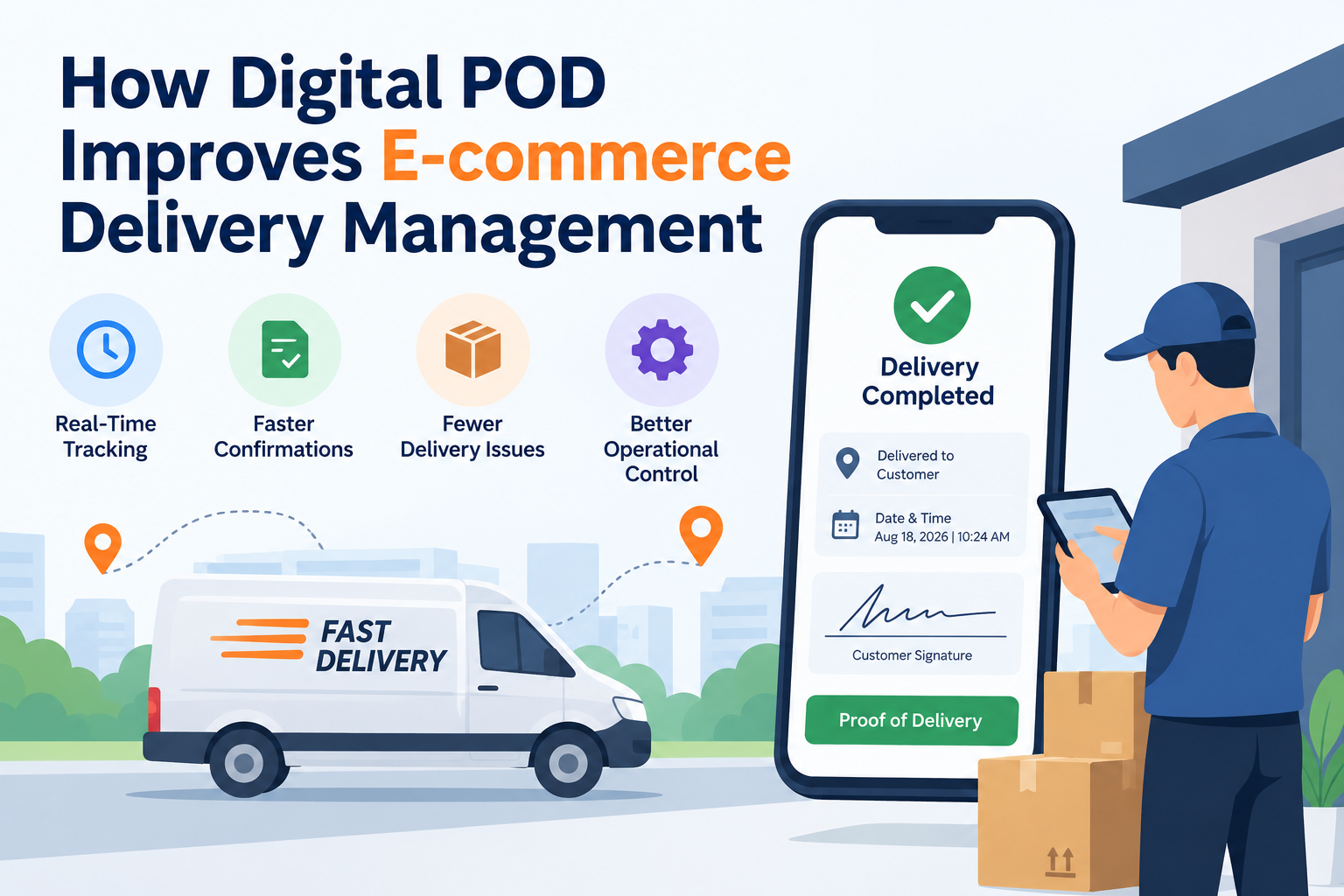
E-commerce businesses handle thousands of deliveries every day, and managing those deliveries efficiently can be challenging. Customers expect fast delivery, accurate tracking, and proof that their orders were delivered successfully.
One important technology helping businesses solve these challenges is Digital Proof of Delivery (POD).
Traditional delivery operations often depend on paper-based delivery receipts, signatures, and manual data entry. These processes can create delays, paperwork, and difficulties when businesses need to verify a delivery.
With digital POD, delivery teams can capture proof of delivery electronically and make the information available to the business almost immediately.
When integrated with E-commerce Delivery Management Software, digital POD can improve delivery visibility, reduce administrative work, speed up reconciliation, and create a better customer experience.
Digital Proof of Delivery is an electronic record confirming that a shipment or order has been successfully delivered to the customer.
Instead of using physical delivery receipts, drivers can use a mobile device to capture important delivery information such as:
Customer name and delivery details
Date and time of delivery
Digital signature
Delivery photos
GPS location
Delivery status
Notes about the shipment
Damaged or missing item information
Once the delivery is completed, the information can be uploaded to the central system and accessed by authorized users.
This gives e-commerce businesses a faster and more organized way to confirm completed deliveries.
Delivery is one of the most important parts of the e-commerce customer journey. Even if an order is processed correctly, poor delivery management can result in customer complaints, disputes, and operational costs.
A reliable POD system helps businesses answer important questions quickly:
Was the order delivered?
When was it delivered?
Where was it delivered?
Who received it?
Was the shipment delivered in good condition?
Was there any issue during delivery?
Instead of searching through paper receipts or contacting drivers, businesses can access delivery information digitally.
This is particularly useful for businesses handling a high volume of orders across multiple cities or delivery locations.
One of the biggest advantages of digital POD is faster confirmation.
With traditional paper-based processes, a driver may collect a customer's signature and return the document to the office later. The operations team then needs to manually verify and update the delivery status.
Digital POD removes many of these steps.
As soon as the driver completes the delivery, the delivery information can be recorded electronically. This allows businesses to update shipment statuses faster and maintain better visibility over their delivery operations.
Paper-based POD creates a significant administrative burden.
Delivery teams need to maintain physical receipts, while office staff may have to enter information into spreadsheets or other systems manually.
This can lead to:
Duplicate data entry
Missing documents
Incorrect information
Lost receipts
Delayed updates
Higher administrative workload
Digital POD reduces dependency on physical documents by storing delivery information electronically.
This allows operations teams to spend less time managing paperwork and more time focusing on delivery performance.
Modern e-commerce businesses need visibility across their entire delivery network.
Digital POD can work alongside E-commerce Delivery Management Software to provide a more complete view of the delivery process.
Managers can monitor:
Orders dispatched
Orders in transit
Delivered shipments
Failed deliveries
Delivery exceptions
Pending PODs
Driver performance
When POD information is connected with shipment tracking, businesses can understand what is happening at each stage of the delivery journey.
Delivery disputes can become expensive and time-consuming.
A customer may claim that an order was not delivered, or a business may need to verify whether a shipment reached the correct location.
Digital POD creates an electronic record that can help businesses investigate such situations.
Depending on the system, businesses can maintain supporting information such as:
Digital signatures
Delivery photographs
GPS coordinates
Delivery timestamps
Driver information
Customer remarks
This creates a stronger delivery record and can help businesses resolve disputes more efficiently.
Without centralized delivery information, support teams may need to contact the driver or operations team to find the answer.
With digital POD, authorized teams can quickly access delivery information from the system.
This helps customer service representatives provide faster and more accurate responses.
Better access to delivery information can also improve customer trust.
Cash on Delivery (COD) remains an important payment method for many e-commerce businesses.
Managing COD deliveries manually can create challenges because businesses need to track both the delivery status and the amount collected.
Digital POD can capture delivery-related information and support the reconciliation process by connecting delivery records with order and payment information.
This can help businesses identify:
Delivered COD orders
Pending collections
Collected amounts
Delivery exceptions
Outstanding reconciliation items
When integrated with billing and accounting workflows, this can reduce manual reconciliation work.
Drivers are responsible for completing deliveries accurately and collecting the required proof.
Digital POD creates a clear record of delivery activity.
Businesses can use the information to evaluate:
Delivery completion rates
Failed deliveries
Delivery timestamps
Customer complaints
Proof-of-delivery compliance
Delivery exceptions
This helps managers identify operational issues and improve driver performance.
For larger delivery networks, this level of visibility can become especially valuable.
Not every delivery goes according to plan.
Customers may not be available, addresses may be incorrect, packages may be damaged, or customers may refuse shipments.
Digital POD systems can allow drivers to record these situations directly from their mobile devices.
For example, a driver can mark an order as:
Customer unavailable
Address not found
Customer refused
Package damaged
Partial delivery
Delivery rescheduled
Drivers can also add notes or photos where required.
This gives operations teams better information about why a delivery failed instead of simply seeing a generic “undelivered” status.
E-commerce customers expect accurate order status information.
A digital POD system can connect the final delivery event with the overall shipment lifecycle.
For example:
Order Placed → Order Processed → Dispatched → In Transit → Out for Delivery → Delivered → POD Captured
This creates a clearer delivery workflow.
When delivery status is updated promptly, businesses can provide customers with more accurate shipment information.
Physical POD documents can be difficult to organize, especially when businesses process thousands of deliveries.
Finding a particular receipt may require searching through files, folders, or physical documents.
Digital POD stores delivery records electronically, making them easier to search and retrieve.
Businesses can potentially search records using information such as:
Order number
Shipment number
Customer name
Delivery date
Driver
Location
Delivery status
This can save considerable time for operations and customer service teams.
Growing e-commerce businesses may operate warehouses, fulfillment centers, hubs, and delivery operations across different locations.
Managing POD records across multiple locations can become complicated when using paper-based processes.
A centralized digital system can provide a common platform for managing delivery information across locations.
Managers can get a broader view of delivery operations without depending on individual branches for physical documentation.
Digital POD does more than confirm completed deliveries. The data generated through delivery operations can also help businesses analyze performance.
Businesses can identify patterns such as:
Frequent delivery failures
Delays in particular areas
Driver performance issues
High-return locations
Repeated customer complaints
Delivery completion trends
These insights can help management make better operational decisions.
For example, if a particular area has consistently high failed deliveries, the business can investigate address quality, customer availability, delivery timing, or route planning.
The real value of digital POD increases when it is connected with broader E-commerce Management Software.
A typical workflow can look like this:
The customer's order is received through the e-commerce platform or order management system.
The order is picked, packed, and prepared for dispatch.
The shipment is assigned to a delivery executive, vehicle, or delivery partner.
The business monitors the shipment as it moves toward the customer's location.
The driver reaches the customer and completes the delivery.
The driver captures the required proof, such as a signature, photo, location, timestamp, or delivery note.
The completed delivery and POD information are synchronized with the central system.
Operations, customer service, billing, and management teams can use the delivery information for verification, reporting, reconciliation, and performance analysis.
This connected workflow reduces the need for separate manual processes.
If your business is planning to implement digital POD, consider software that provides features such as:
Allows customers to electronically confirm receipt of their orders.
Drivers can capture delivery photos when visual confirmation is required.
Location information can help verify where the delivery was completed.
Records the exact date and time of the delivery event.
Drivers should be able to capture POD information easily from their smartphones or mobile devices.
Useful when drivers operate in areas with limited internet connectivity.
Delivery information should synchronize with the central system when connectivity is available.
Drivers should be able to record failed deliveries, damaged shipments, customer refusals, and other exceptions.
Managers should be able to analyze delivery performance using POD data.
When implemented effectively, digital POD can provide several business benefits:
Faster delivery confirmation
Reduced paperwork
Lower administrative workload
Better delivery visibility
Easier dispute resolution
Improved customer service
Better driver accountability
Faster COD reconciliation
Easier document retrieval
Better delivery performance analysis
Improved operational efficiency
These benefits become even more valuable as an e-commerce business grows and manages a larger delivery network.
Yes.
Digital POD is not limited to large enterprises. Small and growing e-commerce businesses can also benefit from replacing manual delivery documentation with a digital process.
As order volumes increase, managing delivery records through spreadsheets, WhatsApp messages, and paper receipts can become difficult.
Implementing digital POD early can help create a more structured delivery process and make it easier to scale operations.
Before selecting a solution, businesses should consider their delivery volume, operating model, number of delivery locations, and existing software ecosystem.
Look for a solution that can integrate with:
Order management systems
E-commerce platforms
Delivery management software
Fleet management systems
Billing software
Accounting systems
GPS tracking platforms
The goal should be to create a connected workflow instead of adding another isolated tool.
Digital POD is becoming an important part of modern e-commerce delivery management.
It replaces slow paper-based processes with faster digital delivery confirmation while giving businesses better access to shipment information.
From reducing paperwork and improving customer service to supporting dispute resolution and COD reconciliation, digital POD can improve several areas of delivery operations.
For growing e-commerce businesses, combining Digital POD Software, shipment tracking, route optimization, and Part Truckload Managеmеnt Softwarе can create a more organized and scalable delivery ecosystem.
As customer expectations continue to increase, businesses that invest in better delivery visibility and digital processes can gain stronger control over their logistics operations.