 English
 Arabic
 French
 Spanish
 Portuguese
 Deutsch
 Turkish
 Dutch
Dutch
 Italiano
 Russian
 Romaian
 Portuguese (Brazil)
 Greek
Greek
Why the Ultra-Low Temperature Freezer Market Is Gaining Momentum Globally
Music |
2026-06-12 06:31:49
 Social Networth OS
 Creator Commerce
 Launch Startup
 Global News
 Creator Award
 Talkfever App
See All
Talkfever App
See All

Upgrade to Pro
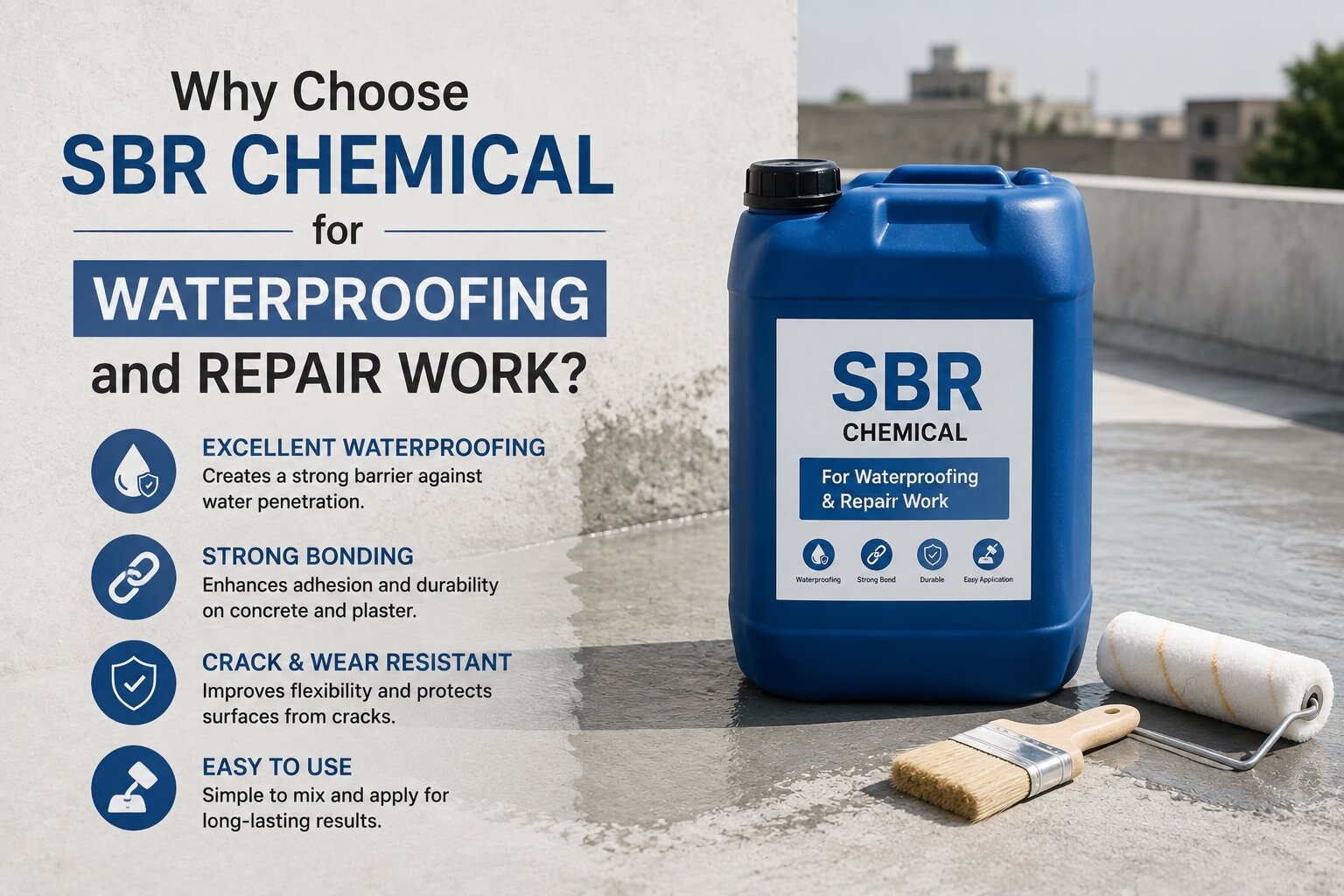
Waterproofing and concrete repair are essential for protecting buildings and infrastructure from moisture, cracking, abrasion, and long-term deterioration. Concrete may appear strong, but repeated exposure to water, temperature changes, movement, and mechanical stress can gradually affect its performance.
One practical way to improve cement-based repair and waterproofing systems is through polymer modification. Styrene-Butadiene Rubber (SBR) is a synthetic latex polymer used to improve important properties such as adhesion, flexibility, water resistance, and durability. Hutaib's construction-chemical portfolio identifies SBR chemicals as latex modifiers for concrete and mortar, with applications including repair mortars, waterproof coatings, and screeds.
When the appropriate SBR is correctly formulated and applied, it can help construction materials perform more reliably in demanding environments.
SBR is valuable because it can modify the behavior of cementitious materials rather than simply adding another layer of protection. When incorporated into an appropriate cement-based formulation, the polymer can improve the interaction between the components and contribute to a denser, more cohesive material.
This is particularly useful when a repair must bond to an existing concrete surface or when a waterproofing layer needs to tolerate some degree of movement.
Repair work often involves placing new mortar over an existing concrete substrate. If the bond between the two surfaces is weak, the repair may separate, crack, or deteriorate prematurely.
An SBR-modified system can improve adhesion between the repair material and the prepared substrate. This makes polymer modification useful for patch repairs, bonding coats, screeds, and other cement-based applications where good substrate adhesion is important.
Water can enter porous concrete and contribute to deterioration over time. SBR-modified materials can help reduce permeability and improve water resistance, making them useful in areas exposed to moisture.
The exact level of water resistance depends on the formulation, cement-to-polymer ratio, substrate condition, thickness, curing, and application technique. SBR should therefore be viewed as one component of a properly designed waterproofing system rather than a universal solution for every water-related problem.
Repair mortars must do more than fill a damaged section. They need to remain bonded to the existing substrate while coping with mechanical and environmental stresses.
SBR can help improve the performance of cementitious repair mixtures by modifying their adhesion, flexibility, and resistance characteristics.
When a damaged concrete area is repaired, the new material needs to remain securely attached to the old surface. Poor adhesion can create a weak interface where water and contaminants can enter.
An SBR-modified repair system can provide improved bonding characteristics, particularly when the substrate has been correctly cleaned and prepared. This can be beneficial for repairs involving concrete floors, walls, slabs, steps, industrial surfaces, and other cement-based structures.
Traditional cement materials are relatively rigid. Shrinkage, temperature fluctuations, vibration, and minor movement can place stress on a repair.
Polymer modification can provide greater flexibility and toughness compared with an unmodified cementitious system. This does not make concrete permanently flexible, but it can help the repaired area respond better to certain stresses.
For this reason, SBR can be useful where a repair needs a combination of adhesion, mechanical performance, and improved resistance to cracking.
SBR has applications across several construction and maintenance activities. Its suitability depends on the specific grade and formulation, so product selection should always be based on the intended use.
SBR-modified cementitious coatings can be considered for areas where surfaces are regularly exposed to water or damp conditions. These may include bathrooms, balconies, terraces, water-related structures, and selected below-ground applications.
A properly designed system can help reduce water penetration while maintaining good adhesion to the substrate. However, joints, cracks, corners, pipe penetrations, and movement areas also need appropriate treatment.
Repair mortars containing SBR can be used where damaged or deteriorated cement-based materials need restoration. The polymer can improve the bonding and performance of the repair mixture.
Typical repair situations include surface deterioration, local patching, worn concrete, damaged edges, and repairs associated with maintenance work.
Flooring systems experience continuous mechanical stress from people, vehicles, equipment, and cleaning operations. SBR-modified screeds and repair layers can provide improved adhesion and durability for selected flooring applications.
They can be particularly useful where a cementitious layer needs better performance than a conventional sand-and-cement mixture.
Certain SBR formulations can be used in bonding coats between existing substrates and new cementitious materials. The purpose is to improve the interface so that the new layer remains firmly attached.
The exact application method depends on the product formulation and technical recommendations.
Waterproofing requires more than simply preventing visible water from passing through a surface. A successful system must also remain attached, resist environmental stresses, and maintain its performance over time.
SBR can contribute to these requirements through several properties.
| Property | Importance in construction applications |
|---|---|
| Adhesion | Helps cementitious materials bond effectively to prepared substrates. |
| Water resistance | Helps reduce permeability and limit moisture penetration through suitable systems. |
| Flexibility | Helps accommodate certain minor movements and stresses without becoming excessively brittle. |
| Abrasion resistance | Helps surfaces withstand repeated mechanical contact and everyday wear. |
| Toughness | Can improve the ability of modified materials to tolerate demanding service conditions. |
| Surface durability | Supports longer-lasting performance when the complete system is correctly designed. |
These properties explain why SBR chemical for waterproofing is used in construction formulations where ordinary cement-based materials may require additional performance.
Concrete is naturally porous. If moisture repeatedly enters the material, it can contribute to deterioration, particularly when combined with cracks, salts, temperature changes, or other environmental factors.
SBR modification can help create a more cohesive cementitious matrix and reduce the ease with which water moves through the treated material.
A suitably formulated SBR-cement system can reduce the pathways through which water travels. This can help protect the underlying substrate from repeated moisture exposure.
The result is especially useful in applications where a cementitious coating or repair layer must provide both physical protection and improved water resistance.
Water is rarely the only source of damage. Waterproofing layers may also encounter cleaning chemicals, abrasion, temperature variation, and mechanical impact.
A polymer-modified system can provide a combination of properties rather than relying solely on water resistance. This broader performance can make it useful for demanding repair and protection applications.
Not every SBR product will perform identically. Different grades can have different characteristics, concentrations, and intended applications.
Selecting the material according to the project's requirements is therefore important.
Start by determining whether the material is required for waterproofing, repair mortar, bonding, flooring, screeds, or another application. The intended use will influence the required polymer characteristics.
For example, a repair mortar may need excellent adhesion and mechanical performance, while a waterproofing coating may place greater emphasis on water resistance and flexibility.
The existing surface should be assessed before material selection. Concrete, masonry, screed, and other substrates can have different levels of porosity, strength, moisture, and surface contamination.
A strong polymer cannot compensate for a weak or poorly prepared substrate.
Technical information should be reviewed before incorporating an SBR chemical into a formulation. Important considerations may include solids content, viscosity, compatibility, recommended dosage, storage requirements, and application recommendations.
For industrial buyers and formulators, technical documentation can help determine whether a particular grade is suitable for the intended product.
Even the best polymer-modified material can fail if the surface underneath is unsuitable. Dirt, grease, loose concrete, old coatings, laitance, and other contaminants can prevent proper adhesion.
The surface should therefore be prepared according to the requirements of the selected system.
Dust, oil, grease, loose particles, and weak material should be removed. Mechanical preparation may be required where the substrate has a weak or contaminated surface.
The objective is to expose a sound surface that can provide reliable adhesion.
Large cracks, holes, deteriorated concrete, and weak sections should be addressed before the main waterproofing or repair layer is applied.
Waterproofing should not be expected to compensate for major structural or substrate defects.
Water frequently finds its way through transitions, corners, joints, pipe penetrations, and wall-floor junctions. These areas require careful detailing because they can become weak points in an otherwise well-applied waterproofing system.
Conventional cement mortar remains useful for many construction applications. However, demanding repair and waterproofing environments may require properties beyond those provided by an ordinary cement-and-sand mixture.
SBR modification can address some of these limitations by introducing polymer-related performance characteristics.
Traditional cement mortars are generally economical and easy to prepare, but their rigidity and permeability can become concerns in applications involving movement, moisture, or demanding adhesion requirements.
Adding an appropriate SBR chemical can improve adhesion, flexibility, water resistance, and toughness. This makes polymer-modified mortars more suitable for certain repair and protection applications where additional performance is needed.
The goal is not to replace conventional cement materials everywhere, but to modify them where the project's performance requirements justify the use of a polymer.
For contractors, manufacturers, and project managers, material selection is closely connected with durability, maintenance, and overall project performance.
Using a suitable SBR-modified system can provide several practical advantages.
These benefits make SBR an important polymer option for construction-material manufacturers and professionals looking to improve the performance of cement-based systems.
Pakistan's construction environment includes a wide range of conditions, from hot and dry areas to regions affected by humidity and seasonal rainfall. Buildings and infrastructure can also face considerable temperature changes, moisture exposure, heavy traffic, and ongoing maintenance demands.
Construction chemical suppliers therefore need to provide materials that can support different formulation and application requirements.
Hutaib Industrial Solutions includes SBR chemicals within its construction-chemical portfolio and describes it as suitable for applications such as repair mortars, waterproof coatings, and screeds. Its broader construction range also includes epoxy resin, admixtures, RDP grades, and styrene acrylic polymers.
For manufacturers and contractors, access to suitable polymer grades can make it easier to formulate construction products according to specific performance requirements.
Correct material selection is only one part of achieving a successful result. Application mistakes can significantly affect the performance of a waterproofing or repair system.
Adding too much or too little polymer can alter the behavior of the final mixture. The recommended formulation should therefore be followed carefully rather than relying on assumptions.
If the underlying concrete is loose, contaminated, or severely deteriorated, the new material may fail regardless of the quality of the SBR.
The substrate's moisture condition should be considered before application. Some systems require damp substrates, while others may have different requirements.
Small surface cracks and structural or moving cracks do not necessarily require the same repair approach. Crack type, width, depth, movement, and location should be evaluated before selecting a treatment.
For industrial or large-scale projects, testing the formulation and application method on a small area can help identify compatibility and performance issues before full application.
Yes, suitable SBR chemicals can be incorporated into cementitious waterproofing systems to improve adhesion, flexibility, and resistance to water penetration. The formulation and application method should match the specific project requirements.
SBR can be used in repair mortars and cement-based repair systems because it can improve bonding, toughness, flexibility, and durability. Proper surface preparation remains essential for successful repairs.
SBR does not guarantee that concrete will never crack. However, polymer modification can improve flexibility and toughness and may help reduce certain cracking problems when the system is properly designed and applied.
Yes, suitable SBR chemicals can be used in cementitious flooring systems, screeds, resurfacing materials, and repair layers. The appropriate grade should be selected according to traffic, abrasion, adhesion, and environmental requirements.
No. SBR chemicals can differ in formulation and performance characteristics. Buyers should review technical specifications and application recommendations to select a grade appropriate for waterproofing or repair work.
SBR is a valuable polymer modifier for construction applications where ordinary cement-based materials need improved adhesion, flexibility, water resistance, toughness, and durability. Its use in repair mortars, waterproofing systems, screeds, flooring materials, and bonding applications makes it relevant to both construction professionals and manufacturers of formulated building products.
However, successful performance depends on the complete system. The SBR chemical, cement formulation, mixing ratio, substrate preparation, application thickness, curing conditions, and environmental exposure all need to be considered.
For projects where moisture protection and durable repairs are important, a properly selected SBR-modified system can provide a practical way to improve the performance and service life of cementitious construction materials.


