 English
 Arabic
 French
 Spanish
 Portuguese
 Deutsch
 Turkish
 Dutch
Dutch
 Italiano
 Russian
 Romaian
 Portuguese (Brazil)
 Greek
Greek
Next-Generation Airborne Intelligence Systems Support Long-Term Growth in the Aerial Sensor Market
Music |
2026-05-13 09:07:18
 Social Networth OS
 Creator Commerce
 Launch Startup
 Global News
 Creator Award
 Talkfever App
Mostra tutti i risultati
Talkfever App
Mostra tutti i risultati

Passa a Pro
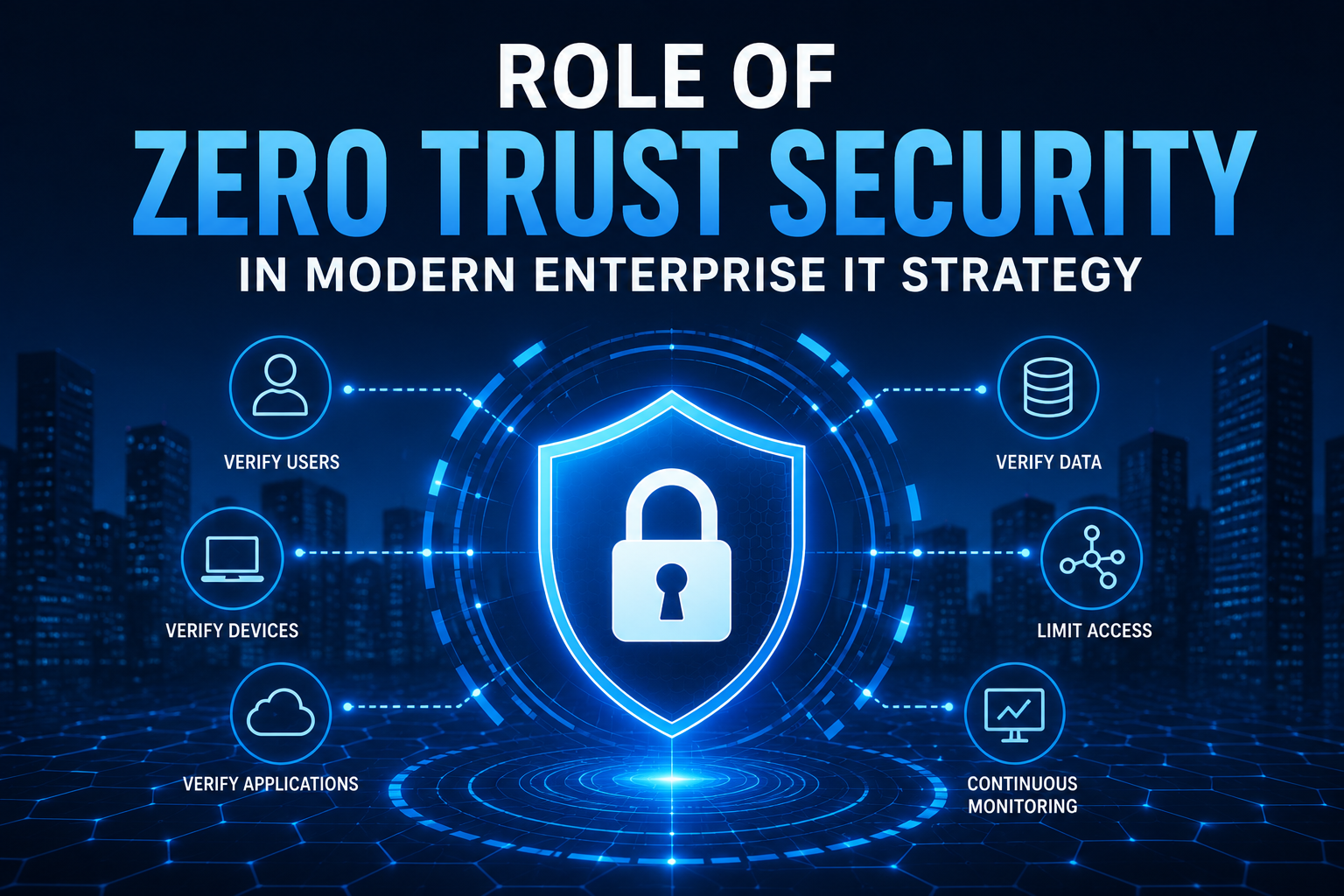
75% of breaches in 2025 didn't involve anyone breaking through a firewall. The attackers just logged in with stolen credentials through trusted sessions using accounts the network had no reason to question. That success explains why the old model of perimeter-based security is gone and why Zero Trust has moved from a theoretical framework to the architecture most enterprise IT teams are being told to build right now.
Zero Trust is not a product. It's a security model built on one principle: no user, device, or system gets automatic trust, ever regardless of whether they're inside or outside the corporate network. Every access request is verified. Every session is monitored. The moment behavior shifts, access gets re-evaluated. The phrase Forrester Research coined in 2010 when they first defined the concept "never trust, always verify" is still the most accurate summary of what Zero Trust actually means in practice.
This article covers:
Why perimeter security failed and what replaced it
What Zero Trust actually requires inside an enterprise
Where adoption stands in 2026 and what's holding organizations back
The financial case for implementation
The traditional security model assumed that everything inside the network was safe. You built a strong wall around the perimeter: firewalls, VPNs, and access controls at the edge and trusted that anything that got through was legitimate. That assumption held reasonably well when employees worked from a single office and applications lived on servers in the basement.
It collapsed when work went hybrid, applications moved to the cloud, and contractors started accessing systems from three continents. The perimeter didn't disappear. It just became meaningless.
The 2024 Snowflake credential-theft campaign demonstrated this clearly: attackers used stolen login credentials to compromise roughly 100 customer accounts and pulled data across multiple cloud tenants without triggering a single perimeter alarm. The same pattern showed up in the waves of Okta and Microsoft Entra ID token theft attacks in 2023 and 2024. In both cases, organizations with strong perimeter defenses suffered serious breaches because internal traffic was implicitly trusted after authentication. Once someone was in, they could move.
412 billion credential stuffing attempts were recorded in the past year alone. 84% of organizations experienced identity-related breaches in 2025, with attackers spending an average of 11 days moving laterally through networks before detection. That 11-day window is what Zero Trust is designed to close by enforcing verification at every hop, not just at the door.
The implementation question trips up most organizations because Zero Trust isn't a single technology or a switch you flip. It's an architecture built across several layers simultaneously.
|
Zero Trust Layer |
What It Requires |
Why It Matters |
|
Identity verification |
Phishing-resistant MFA (FIDO2/WebAuthn), continuous session monitoring |
72% of breaches involve privileged credential exploitation |
|
Device health checks |
Real-time device posture validation before and during access |
Compromised devices are as dangerous as stolen passwords |
|
Micro-segmentation |
Dividing the network into isolated zones; limiting lateral movement |
Attackers who get in can't move freely through the environment |
|
Least-privilege access |
Users and systems get only what they need for each specific task |
Reduces blast radius when credentials are compromised |
|
Continuous authorization |
Trust isn't granted once it's re-evaluated throughout the session |
A session authenticated at 9 AM shouldn't carry the same trust at 3 PM if behavior shifts |
|
Machine identity controls |
APIs, microservices, and CI/CD pipelines all require verified credentials |
Non-human identities now outnumber human identities by ratios reaching 144:1 in some enterprises |
That last row matters more than most IT leaders currently account for. The conversation about Zero Trust tends to focus on human users, employees, contractors, and partners. But automated systems, API connections, and AI agents are now generating most of the access requests in a modern enterprise, and they're often running on broadly permissioned service accounts that were set up years ago and never reviewed.
The gap between what organizations say about Zero Trust and what they've actually implemented is wide.
82% of organizations consider Zero Trust essential to their security strategy, yet only 17% have fully implemented it. Per Gartner's forecast, only 10% of large enterprises will have a mature, measurable Zero Trust program in place by the end of 2026, up from less than 1% in 2023. "Mature" in Gartner's definition means continuous evaluation of identity, device, and session risk across the entire estate, not just isolated pilots.
Financial services lead adoption at 50%, driven by regulatory pressure and the direct financial exposure of a breach. Healthcare is the fastest-growing sector for Zero Trust investment, pushed by HIPAA enforcement and a wave of ransomware attacks, 293 ransomware attacks hit healthcare systems in Q1–Q3 of 2025 alone.
What's holding organizations back isn't awareness. It's execution.
|
Implementation Challenge |
% of Organizations Affected |
|
Data governance and classification complexity |
48% |
|
Privacy and compliance concerns across jurisdictions |
30% |
|
Legacy infrastructure incompatibility |
Widely cited across industry surveys |
|
Lack of internal skills to design and operate ZTA |
Consistently reported as a top barrier |
|
Executive buy-in, short-term productivity disruption |
Flagged by security leaders as a persistent obstacle |
The "castle-and-moat" security model is effectively dead. CISOs are no longer asking whether to adopt Zero Trust but how fast they can implement it. The constraint isn't strategic; it's operational. Most organizations have started somewhere. Very few have finished.
For years, Zero Trust was sold on security grounds. The ROI case is now equally strong.
Organizations deploying Zero Trust architecture saved an average of $1.76 million per breach in 2025, ranking it the third most cost-effective security control after tested incident response plans and extensive AI/automation use, per IBM's Cost of a Data Breach Report 2025 drawn from 600 organizations across 17 industries.
Organizations without Zero Trust implementation face breach costs 38% higher than those with it. The U.S. average breach cost reached $10.22 million in 2025, the highest worldwide. For large enterprises weighing the cost of a Zero Trust program against that exposure, the math isn't complicated.
Forrester Research reports organizations with mature Zero Trust implementations experience 50% fewer breaches and reduce breach costs by an average of 43%. Main Line Health, a 50,000-user healthcare system, deployed identity-based micro-segmentation in three weeks in 2025 and had active blocking rules live within 48 hours without a network redesign. The assumption that Zero Trust requires 18 months and a complete infrastructure overhaul is one of the most persistent myths holding organizations back.
The market numbers reflect where investment is heading. The global Zero Trust market was estimated at $38.37 billion in 2025 and is projected to reach $86.57 billion by 2030, with a CAGR of 17.7%. Zero Trust Network Access is growing fastest within that market at a 21.8% CAGR.
What is Zero Trust security in plain terms?
It's a security model that assumes no user, device, or system should be trusted automatically, regardless of whether they're already inside the network. Every access request gets verified, every session gets monitored, and access is granted based on identity, device health, and behavior at that specific moment rather than a one-time check at login.
Is Zero Trust a product you can buy?
No. It's an architecture and a set of principles implemented across identity, devices, networks, applications, and data. Organizations typically use a combination of tools, identity providers, endpoint detection platforms, ZTNA solutions, and micro-segmentation software to build it out. No single vendor delivers Zero Trust out of the box.
Why are so many organizations stuck at partial implementation?
The most common blockers are legacy infrastructure that wasn't built for continuous verification, data governance complexity, skills gaps in-house, and the short-term productivity disruption that comes with enforcing stricter access controls on people who were used to broader permissions. Most organizations have started Zero Trust somewhere; few have completed it end to end.
Does Zero Trust stop ransomware?
It significantly limits ransomware's ability to spread. Micro-segmentation means an attacker who compromises one system can't move freely through the network. Least-privilege access means the blast radius of a compromised account stays contained. It doesn't prevent initial compromise, but it reduces what an attacker can do after they're in, which is where most of the damage in ransomware attacks actually happens.
What's the biggest Zero Trust mistake enterprises make?
Starting with technology before defining the data and systems that actually need protecting. A Zero Trust implementation that begins with "Which tools should we buy?" tends to result in fragmented coverage. The organizations that implement it most effectively start by mapping their most sensitive data flows, defining who legitimately needs access to what, and building verification requirements from there outward.

