


 IMS for Investors
 Global News
 Vdo Junction
 Talkfever App
 Upcoming
Global Modular and Prefabricated Construction Market Forecast 2025–2035: Market Expansion Driven by Labor Shortages
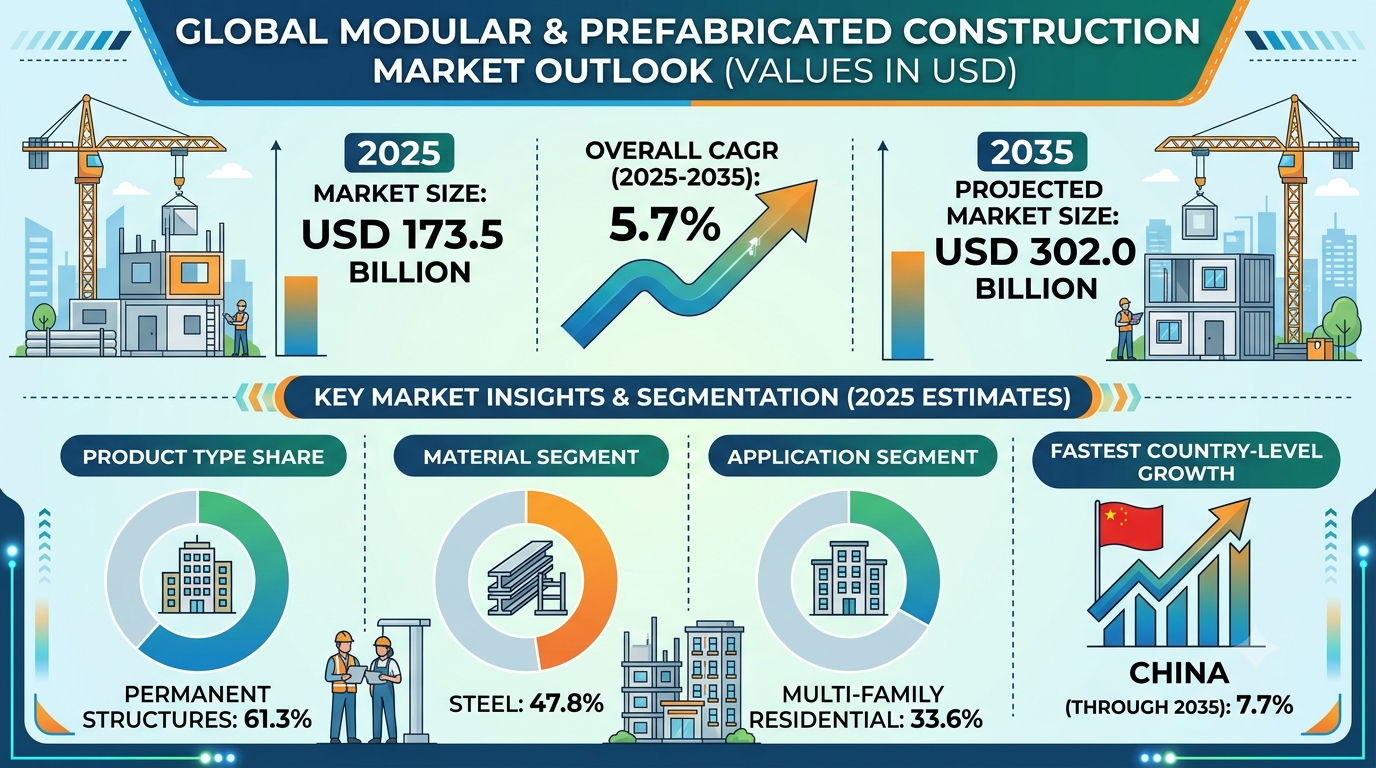
The global modular and prefabricated construction market is projected to witness strong expansion over the next decade, supported by pressing needs for faster project delivery and rising adoption of off-site manufacturing across the construction industry. The market is expected to grow steadily, reaching approximately USD 302.0 billion by 2035, registering a CAGR of 5.7%, according to the latest analysis by Future Market Insights (FMI).
Market growth is being shaped by increasing project time optimization, growing labor shortages in traditional construction, and rapid adoption of sustainable building methods. Prefabricated structures have evolved from alternative building choices into essential structural solutions across residential, commercial, and institutional projects worldwide. While permanent structures continue to dominate installations, developers are increasingly integrating hybrid modular systems and advanced technologies to comply with modern building codes and improve cost predictability outcomes.
Global Modular and Prefabricated Construction Market Snapshot (2025–2035)
- Market size outlook toward 2035: USD 302.0 billion
- Forecast CAGR: 5.7% (2025 to 2035)
- Dominant product category: Permanent modular structures (61.3% share in 2025)
- Fastest-growing country segment: China (~7.7% CAGR through 2035)
- Key growth regions: North America, Western Europe, South Asia & Pacific, East Asia
- Primary demand channel: Multi-family residential applications (33.6% share in 2025)
Momentum in the Market
Beginning from steady industrial adoption levels, the global modular and prefabricated construction market demonstrates accelerated growth throughout the forecast period as off-site construction becomes vital across multiple countries. Between 2025 and 2035, expanding urban housing programs and rising investments in public infrastructure are expected to significantly boost demand for integrated building systems. Increasing urbanization and higher traffic density are encouraging governments and developers to prioritize rapid-deployment occupant protection and infrastructure technologies.
From 2035 onward, innovation in intelligent building information modeling (BIM) systems and integration with advanced digital twin technologies is expected to further strengthen market expansion. Smart prefabricated modules capable of adapting layouts based on factory precision and site requirements are emerging as key differentiators in new real estate projects.
Request a Sample Report: https://www.futuremarketinsights.com/reports/sample/rep-gb-23063
The Reasons Behind the Market’s Growth
Demand for modular and prefabricated construction is rising due to multiple structural and technological factors reshaping the global construction ecosystem.
Project Time Optimization Growing emphasis on speed and cost predictability has propelled the demand for modular solutions. Real estate developers integrate prefabricated modules into projects to reduce delays linked to weather and traditional site issues.
Labor Shortages and Site Delays Offsite construction methods allow developers to work around severe labor gaps. Factory assembly reduces on-site labor requirements and associated safety risks.
Sustainability Targets Tightening environmental regulations favor off-site production, as builders significantly reduce material waste, optimize resource planning, and improve energy efficiency.
Urbanization and Affordable Housing Rapid urban population growth creates a critical need for scalable, fast, and cost-effective housing solutions, encouraging government-backed housing programs to prioritize modular structures.
Top Segment Application Type
Multi-Family Residential Leads Market Demand Multi-family residential applications account for the majority of modular installations across global markets, supported by increasing high-density urban housing programs requiring efficient and scalable delivery.
Material and Product Analysis
- Permanent Structures: ~61.3% market share in 2025, driven by acceptance as durable alternatives to traditional buildings.
- Steel Material: ~47.8% market share in 2025, supported by its superior strength-to-weight ratio and recyclability.
- Multi-Family Residential: ~33.6% market share in 2025, leading application demand due to urban land scarcity.
- China Expansion: ~7.7% CAGR, the fastest-growing country-level expansion globally through 2035.
Regional Development: Manufacturing Ecosystem Drives Expansion
The global landscape is rapidly evolving into an industrialized manufacturing hub for building components, supported by computerized pre-engineering and expanding developer networks.
- China: The global expansion leader, deploying industrialized construction at an unprecedented urban scale.
- India: Seeing strong adoption as public housing and infrastructure projects transition to faster building methods.
- North America & Western Europe: Expanding assembly capabilities to counteract high local labor costs and meet strict green building mandates.
Localized manufacturing partnerships between modular suppliers and traditional general contractors are improving cost efficiency while accelerating technology adoption across regions.
Challenges, Trends, Opportunities, and Drivers
Drivers
- Project time optimization and fast delivery
- Severe labor shortages in traditional trades
- Government push for affordable public housing
- Enhanced factory quality control and cost predictability
Opportunities
- Hybrid modular systems for high-rise applications
- Integration with BIM and digital twin planning platforms
- Lightweight and green-certified building materials
- Rapid deployment modules for healthcare and data centers
Trends
- Transition toward advanced automated factories
- Increased use of multi-material composite systems
- Increased integration of prefabricated mechanical, electrical, and plumbing (MEP) systems
- Sustainability-focused zero-waste circular manufacturing
Challenges
- High initial transportation and logistical costs for large modules
- Complex design limitations for complex custom architectures
- Compliance with varying local building codes and zoning laws
Country Growth Outlook
The market’s growth trajectory is closely tied to urban industrialization and regulatory implementation across major economies:
- China: High volume manufacturing leadership and massive urban infrastructure enforcement.
- India: Expanding public housing construction capacity via offsite methods.
- United States: Increasing multi-family and commercial real estate adoption.
- Western Europe: Leading the adoption of energy-efficient and low-carbon modular building envelopes.
The Competitive Environment
The global modular and prefabricated construction market is moderately consolidated, with global construction technology providers and massive engineering firms competing through structural innovation, localized factory networks, and regulatory compliance.
Leading companies include:
- Skanska
- ACS Group
These players are investing heavily in automated factory lines, advanced lightweight materials, and hybrid construction systems while forming partnerships with regional real estate developers to strengthen supply chains and accelerate structural development.
Future Outlook: Toward Intelligent and Sustainable Infrastructure
The modular and prefabricated construction market is entering a transformative decade shaped by automation, digital construction workflows, and stricter sustainability expectations. Future modular systems are expected to function as highly integrated, high-performance units working alongside green building technologies such as solar integration and smart energy management. As global construction markets mature and efficiency demands strengthen, prefabricated methods will remain central to achieving faster, smarter, and more sustainable real estate ecosystems throughout the world.
For a comprehensive strategic outlook and detailed analysis of technological developments shaping the industry, readers can explore the full report on the official Future Market Insights website: https://www.futuremarketinsights.com/reports/modular-prefabricated-construction-market
- Art & Craft
- Causes & Effect
- Dance & Music
- Health & Fitness
- Food & Wellness
- Historic Places
- Homes & Gardening
- Literature & Knowledge
- Science and Technology
- Social Networking
- Social Commerce
- Party & Celebration
- Religion & Festivals
- Shopping & Vendors
- Sports & Games
- Film & Theater
- Digital Creators & Community
- Influencer CCC
- Corporate & Collaboration
- Startup & Scope
- Investment & Growth
- VC & Angel Investors
- Agriculture & farmers
- Nature & Universe
- News & Media
- Real Estate & Property
- Artificial Intellegence
- Political Coverage
- Winners & Loosers
 Arabic
 English
 Hindi
Hindi
 French
 Spanish
 Portuguese
 Deutsch
 Turkish
 Dutch
Dutch
 Italiano
 Russian
 Romaian
 Portuguese (Brazil)
 Greek
Greek
