English
 Arabic
 French
 Spanish
 Portuguese
 Deutsch
 Turkish
 Dutch
Dutch
 Italiano
 Russian
 Romaian
 Portuguese (Brazil)
 Greek
Greek
Protein Crystallization Market Industry Analysis, Size, Share, Growth Factors, By Solution Type, End user, Application
Health |
2025-04-30 10:22:50
 Social Networth OS
 Creator Commerce
 Launch Startup
 Global News
 Creator Award
 Talkfever App
See All
Talkfever App
See All

Upgrade to Pro
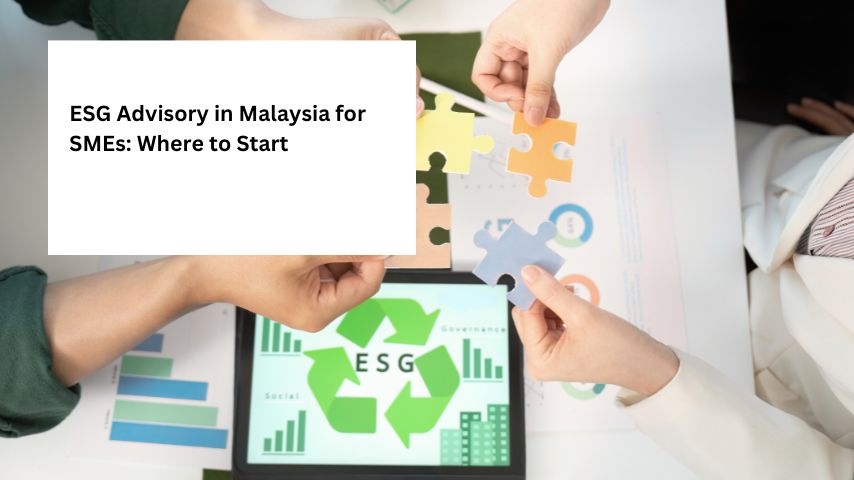
ESG advisory in Malaysia is no longer a conversation that only large corporations and listed companies need to have. If you run an SME in Malaysia — whether you're in manufacturing, services, construction, food production, or technology — ESG is already arriving at your door. It may show up as a supplier questionnaire from your biggest customer, a lender asking about your sustainability credentials, or a new hire asking what your company stands for beyond profit.
The good news is that you don't need to have all the answers yet. What you do need is a clear starting point — and this guide is built to give you exactly that.
We'll walk through why ESG matters for Malaysian SMEs right now, what ESG advisory actually involves at your scale, how to cut through common misconceptions, and a practical roadmap you can use to move from zero to credible progress without overwhelming your team or your budget.
Many SME owners assume ESG is primarily a concern for public-listed companies navigating Bursa Malaysia ESG requirements. That assumption is increasingly inaccurate.
The pressure on SMEs is coming from three directions at once — and all three are intensifying.
Malaysia's manufacturing, electronics, and commodity sectors are deeply embedded in global supply chains. The multinational buyers at the top of those chains — automotive brands, consumer electronics companies, FMCG multinationals — face stringent ESG expectations from their own investors and regulators in Europe, Japan, and North America.
To meet those expectations, large buyers are cascading ESG requirements down to their suppliers. That means Malaysian SMEs supplying Tier 1 or Tier 2 buyers are now routinely asked to complete ESG questionnaires, provide carbon emissions data, demonstrate labor compliance, and show evidence of a sustainability strategy.
If you can't answer these questions adequately, you risk losing contracts — not because of poor product quality or pricing, but because you failed an ESG vendor assessment.
Bank Negara Malaysia's green taxonomy, sustainability-linked loan products from commercial banks, and ESG-linked facilities from development finance institutions like SME Bank and MIDF are increasingly tying financing eligibility to ESG performance.
This doesn't mean you need a published sustainability report to get a business loan. But it does mean that lenders are beginning to factor ESG credentials into credit assessments — and SMEs that can demonstrate basic ESG awareness and data tracking will have access to a broader range of financing options, often at better terms.
Green financing in Malaysia is not a future trend. It's available now, and ESG readiness is a real determinant of who qualifies.
Sustainability reporting Malaysia requirements currently mandate formal disclosures for Bursa Malaysia Main Market listed companies. SMEs are not yet directly mandated. But the trajectory is clear: regulatory requirements are expanding, frameworks are converging toward ISSB-aligned standards, and there is a reasonable expectation that mandatory disclosure obligations will eventually reach larger SMEs in high-impact sectors.
Starting now — even at a basic level — means you build your ESG capability incrementally, rather than scrambling to meet a compliance deadline with no data history and no internal systems.
Before getting into the practical roadmap, it's worth clearing up a few ideas that hold SME leaders back from engaging with ESG.
"ESG is just for big companies."
Scale affects the complexity of ESG work, not its relevance. Supply chain requirements, financing criteria, and talent expectations don't exempt SMEs — they just arrive through different channels.
"We already do CSR, so we're covered."
CSR and ESG are not the same. CSR is typically philanthropic, narrative-driven, and voluntary. ESG is performance-based, metrics-focused, and tied to business and regulatory expectations. Donating to a community fund does not address your carbon emissions, labor practices, or board governance — all of which ESG stakeholders assess.
"ESG is too expensive for an SME."
Engaging an ESG consultant in Malaysia doesn't require a six-figure budget. Many advisory engagements for SMEs start with a targeted gap analysis or materiality assessment that can be scoped to match your current resources. The cost of starting small is low. The cost of being unprepared when a major buyer or lender asks for ESG data can be much higher.
"We don't have enough data to start."
You don't need perfect data to begin. A good ESG advisor will help you identify what data matters, build simple collection processes, and establish a baseline from which you can improve over time. Starting without data is the norm, not an exception.
When an SME engages ESG advisory in Malaysia, it doesn't look the same as a listed company's multi-year sustainability program. The scope is more targeted, the deliverables are more practical, and the starting point is usually simpler than most business owners expect.
An ESG consultant in Malaysia with deep expertise in sustainability strategy will typically begin working with an SME from one of the following starting points, depending on what triggered the engagement:
Supply chain readiness: If you've received a supplier ESG questionnaire you don't know how to answer, an advisor can help you understand what's being asked, identify your current position, and prepare credible responses — while building the internal systems that make future questionnaires easier to handle.
Financing preparation: If you're exploring green loans or sustainability-linked financing, an advisor can help you understand what ESG criteria the relevant lender applies, assess your current eligibility, and create a roadmap for meeting any gaps.
Baseline assessment: If you're starting from scratch with no specific trigger, a baseline assessment maps your current ESG performance across environmental, social, and governance dimensions, identifies your biggest gaps, and prioritizes where to focus first.
Reporting preparation: If your business is approaching a point where a sustainability disclosure may be expected — by an investor, a listed-company client, or a regulatory body — an advisor can help you structure and produce your first report in a way that's credible and proportionate to your size.
In all cases, the advisory work should leave your team with more capability than it started with, not a polished report and a knowledge gap that requires another expensive engagement to fill.
Here's a step-by-step approach designed for SMEs starting from a low or zero ESG baseline.
Before deciding what to do, clarify why ESG matters to your specific business right now. Ask yourself:
· Have any of your major customers sent ESG questionnaires or made sustainability requirements a condition of your supplier relationship?
· Have any lenders mentioned ESG credentials as part of financing discussions?
· Do you have investors, shareholders, or board members asking about ESG performance?
· Are any of your key clients themselves listed companies navigating Bursa Malaysia ESG requirements?
· Is your sector — manufacturing, construction, agriculture, logistics — high on the radar for environmental or social scrutiny?
Your answers tell you which ESG issues are most urgent and what a practical first engagement should address. Not every SME needs to start in the same place.
A materiality assessment identifies which ESG topics are most significant to your business and the stakeholders it affects. For an SME, this doesn't need to be a complex multi-month process. A focused assessment — involving your leadership team, a sample of key customers, and possibly a few suppliers and employees — can produce a clear picture of your material ESG topics in four to six weeks.
The output is a prioritized list of ESG issues that your strategy, data collection, and eventual disclosures should focus on. This prevents the common mistake of trying to track and report on everything, which quickly becomes unmanageable for a small team.
For each of your priority ESG topics, identify the simplest way to start measuring performance. This doesn't require expensive software or a dedicated sustainability manager. It requires clear ownership — someone responsible for collecting and recording data — and a consistent approach.
Common starting metrics for Malaysian SMEs include:
· Environmental: Electricity consumption (monthly, in kWh), fuel usage for company vehicles and machinery, water consumption, and waste volumes (with a basic segregation between general waste and recyclables)
· Social: Headcount by gender, employee turnover rate, number of training hours per employee, and workplace incident rates
· Governance: Board composition, anti-corruption policy documentation, supplier code of conduct status, and the existence of a whistleblowing mechanism
You don't need to track all of these from day one. Focus on the metrics most relevant to your material ESG topics and the data your key stakeholders are asking for.
Once you have a baseline, set two or three specific, measurable targets for the next twelve to twenty-four months. These should be meaningful enough to demonstrate genuine commitment, but realistic given your current capacity.
Examples for SMEs:
· Reduce electricity consumption per unit of production by 10% by the end of the financial year
· Achieve gender parity in management roles within two years
· Complete ESG training for all senior managers within six months
· Respond to all major customer ESG questionnaires with verified data by a specific date
Connecting these targets to business outcomes — cost reduction, contract retention, financing eligibility — makes it easier to get internal buy-in from teams who may see ESG as an additional workload rather than a business priority.
Many of the governance and social requirements in ESG frameworks relate to the existence and communication of basic policies. For most SMEs, this is low-hanging fruit: document what your business already does in practice.
Key policies to have in writing include:
· An anti-bribery and corruption policy
· A workplace health and safety policy
· A human rights and labor standards policy (especially relevant for manufacturing and businesses with foreign workers)
· An environmental policy statement
· A supplier code of conduct (for businesses with significant supply chain exposure)
These don't need to be lengthy or complex. A clear, accessible document that reflects actual practice and is communicated to relevant employees and suppliers is far more credible than an elaborate policy document that no one has read.
When you have baseline data, a set of targets, and documented policies, you have the raw material for a basic ESG disclosure. For an SME, this might take the form of a sustainability page on your website, an ESG summary in your annual company report, or a structured response to a customer-driven framework like EcoVadis or CDP.
A first disclosure does not need to align with GRI or ISSB standards in full. It needs to be honest, clear, and consistent with what your data actually shows. An ESG advisor can help you structure it appropriately and ensure it accurately reflects your performance without overstating progress.
Not every ESG advisory firm is structured to work effectively with SMEs. Some are set up primarily for listed companies and will apply frameworks and processes that are disproportionate to your scale. When evaluating ESG consultants in Malaysia, look for:
· SME-specific experience: Ask directly whether they've worked with businesses of your size and sector. The issues that matter for a 50-person manufacturer are different from those facing a listed conglomerate.
· Local regulatory knowledge: Your advisor should understand Bursa Malaysia ESG requirements and Bank Negara Malaysia's green taxonomy well enough to advise on how your business connects to these frameworks — even if you're not listed.
· Practical deliverables: Avoid advisors who lead with complex reporting frameworks before understanding your current baseline. A good SME ESG engagement starts with your situation, not a template.
· Proportionate pricing: ESG advisory for an SME should be scoped and priced to match your scale. If an initial proposal looks like it was designed for a large corporate, ask for a more targeted, phased scope.
· Knowledge transfer: The best outcome is an SME team that understands what it's doing and why — not one that depends on an external consultant to maintain its ESG program indefinitely.
Does my SME have to comply with ESG regulations in Malaysia?
There is no direct mandatory ESG reporting requirement for unlisted SMEs in Malaysia today. However, supply chain requirements from large buyers and lender expectations are creating de facto compliance pressure for many businesses. And mandatory requirements are likely to expand as the regulatory framework matures.
How much does ESG advisory typically cost for an SME?
Costs vary depending on scope and advisor. A focused initial engagement — such as a materiality assessment or supply chain readiness review — can often be scoped for a few thousand to tens of thousands of ringgit. Starting with a clearly defined scope is the most cost-effective approach for most SMEs.
What's the most important ESG issue for my SME?
This depends on your sector, your supply chain, and your key stakeholders. A materiality assessment helps you identify this objectively. Common priorities for Malaysian manufacturing SMEs include carbon emissions and energy efficiency, labor practices, and supply chain transparency.
Do I need to publish a sustainability report?
Not immediately, and not in a formal framework-aligned format unless a specific buyer or lender requires it. A clear internal ESG plan, basic data tracking, and documented policies are a credible starting point that can evolve into formal reporting over time.
Can ESG help my SME access better financing?
Yes. Green loans, sustainability-linked loans, and DFI products in Malaysia increasingly factor in ESG credentials. Even a basic ESG baseline — with documented policies, measurable targets, and some tracking data — can strengthen your financing application.
Strategic ESG advisory in Malaysia is not just for large corporations with sustainability departments and dedicated reporting teams. For SMEs, it's a practical business tool that addresses real and immediate pressures — from supply chain requirements, to financing access, to competitive positioning in markets that increasingly value transparent, responsible business practices.
You don't need to have everything figured out before you start. You need a clear understanding of why ESG matters to your specific business, a prioritized list of the issues that matter most, and a simple, credible first step that gets you moving in the right direction.
The SME owners who will look back in five years and feel grateful they started early are those who treated ESG as a business investment — not a compliance burden. A materiality assessment is the right first conversation to have, and the right ESG consultant will make it a conversation about your business, not a lecture about frameworks.