


 IMS for Investors
 Global News
 Vdo Junction
 Talkfever App
 Upcoming
Recycled PET Market to Witness Continuous Growth by 2035 | Backed by Rising Investments in Recycling Infrastructure
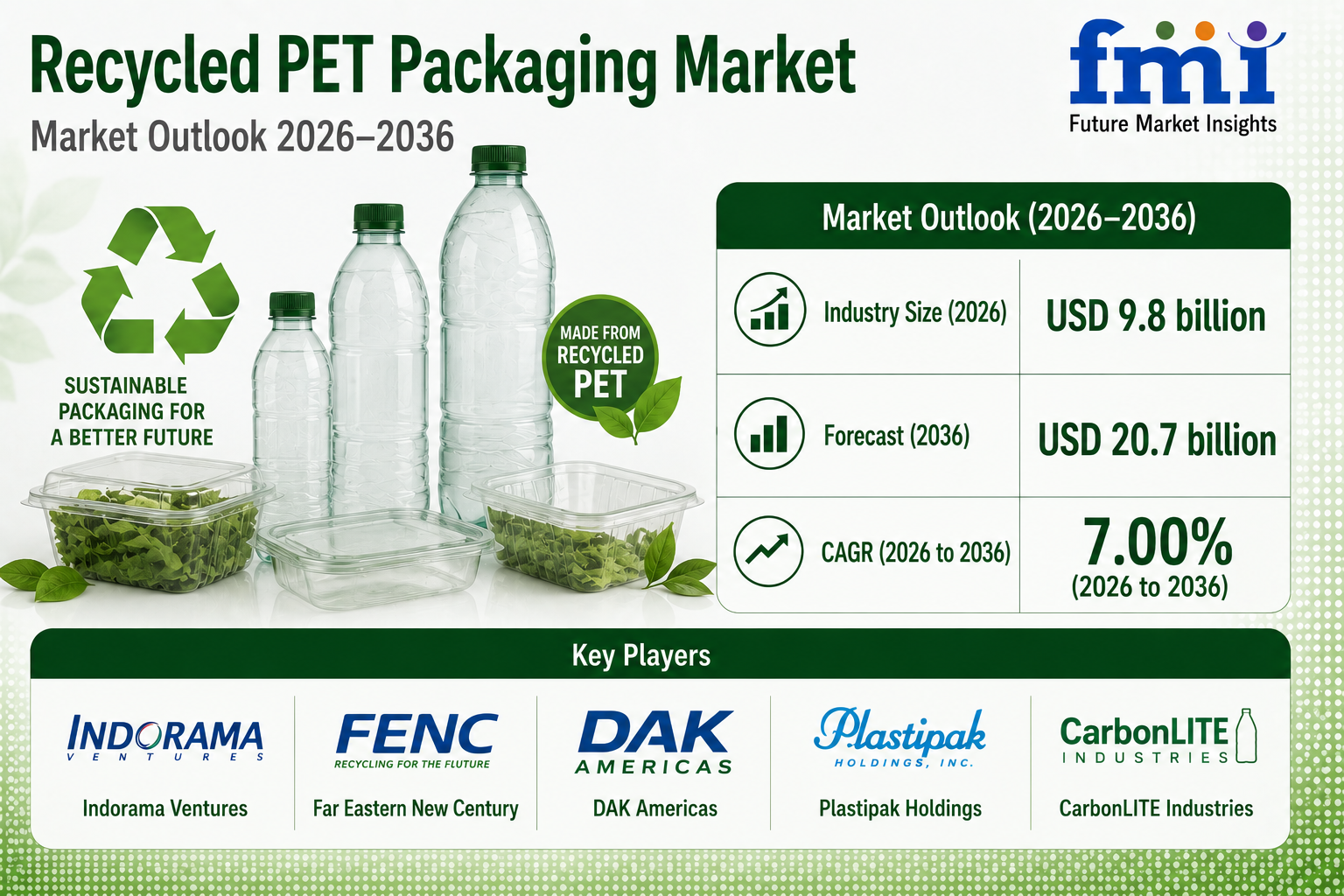
The global recycled PET (rPET) packaging market is projected to witness robust growth over the next decade as beverage producers, consumer goods companies, and packaging manufacturers accelerate the transition toward circular plastic systems and compliance-driven recycled content adoption. Rising regulatory mandates, plastic taxation policies, stronger municipal collection systems, and growing investment in food-grade decontamination technologies are reshaping global PET packaging supply chains.
Recycled PET Packaging Market Snapshot
- Market Size (2026): USD 9.8 billion
- Forecast Value (2036): USD 20.7 billion
- CAGR (2026–2036): 7.0%
- Leading Product Form: Bottles – 52.0% share
- Leading Application Segment: Beverages – 46.0% share
- Dominant Source Segment: Post-Consumer Waste – 72.0% share
- Leading Process Technology: Mechanical Recycling – 78.0% share
Get Detailed Market Forecasts, Competitive Benchmarking, and Pricing Trends: https://www.futuremarketinsights.com/reports/sample/rep-gb-11107
Market Overview
Recycled PET packaging refers to packaging solutions manufactured using recovered polyethylene terephthalate waste collected from:
- Post-consumer plastic bottles
- Municipal recycling streams
- Commercial waste systems
- Industrial PET scrap
Recovered PET materials are:
- Sorted
- Washed
- Decontaminated
- Reprocessed into flakes or pellets
before being converted into:
- Bottles
- Films and sheets
- Fibers
- Strapping materials
- Food-grade packaging formats
The industry is increasingly moving from sustainability-focused initiatives toward compliance-driven mandatory adoption.
Regulatory Pressure Driving Market Expansion
Recycled Content Mandates Accelerating Adoption
Governments globally are implementing mandatory recycled content requirements for packaging manufacturers.
These regulations are forcing beverage brands and FMCG companies to increase the use of:
- Food-grade rPET
- Bottle-to-bottle recycled resin
- Circular packaging systems
Plastic Taxes Reshaping Procurement
Plastic taxation frameworks across Europe and other regulated regions are making virgin PET significantly more expensive, improving the economics of recycled alternatives.
Extended Producer Responsibility (EPR)
EPR policies are shifting packaging waste management costs directly onto producers, encouraging companies to invest in:
- Recycling infrastructure
- Closed-loop collection systems
- Long-term rPET supply agreements
Bottles Lead Product Form Segment
Bottles Hold 52.0% Market Share
PET bottles remain the dominant product category because of:
- High collection rates
- Established recycling systems
- Strong beverage industry demand
- Clear bottle-to-bottle compatibility
Beverage Industry Driving Demand
Major beverage companies increasingly prioritize:
- 100% recyclable bottles
- Clear food-grade recycled resin
- Reduced virgin plastic usage
Why Bottle Applications Dominate
High Recovery Efficiency
Bottle collection systems are highly mature in many regions through:
- Deposit return schemes
- Municipal recycling programs
- Retail collection systems
Mechanical Recycling Compatibility
Clear PET bottle streams are ideal for:
- Mechanical recycling
- Flake purification
- Melt filtration processes
which support cost-efficient large-scale production.
Speak to Analyst: Customize insights for your Business Strategy: https://www.futuremarketinsights.com/customization-available/rep-gb-11107
Beverage Industry Accounts for 46.0% Share
Food-grade Packaging Demand Rising
The beverage sector dominates application demand because:
- PET bottles remain the preferred packaging format for water and soft drinks
- Food-contact approvals require high-purity recycled resin
- Beverage companies face aggressive sustainability commitments
Bottle-to-bottle Circular Systems Expanding
Manufacturers increasingly invest in closed-loop recycling systems that convert used PET bottles directly into new beverage packaging.
Key Beverage Packaging Drivers
Sustainability Targets
Global beverage brands continue announcing:
- Recycled content goals
- Net-zero targets
- Plastic neutrality initiatives
Consumer Expectations
Consumers increasingly prefer:
- Sustainable packaging
- Circular products
- Recyclable beverage containers
Post-Consumer Waste Dominates Feedstock Supply
Post-consumer Sources Hold 72.0% Share
Municipal collection programs and deposit return systems generate the largest supply of usable PET waste.
Improved Collection Infrastructure
Governments and private recyclers continue investing in:
- Optical sorting systems
- Bale purification technologies
- Waste segregation infrastructure
to improve feedstock quality and recovery rates.
Importance of Clean Feedstock
High-quality feedstock is essential for producing:
- Food-grade resin
- Clear bottle applications
- Premium consumer packaging
Mechanical Recycling Maintains Dominance
Mechanical Recycling Holds 78.0% Share
Mechanical recycling remains the preferred processing technology due to:
- Lower capital costs
- Mature infrastructure
- Proven scalability
- Strong compatibility with clear bottle streams
Process Advantages
Mechanical recycling involves:
- Grinding PET into flakes
- Washing and decontamination
- Melt filtration
- Pellet formation
Food-grade Advancements
Modern decontamination systems now enable mechanically recycled PET to meet:
- FDA requirements
- EFSA food-contact regulations
- Beverage industry purity standards
Chemical Recycling Gains Strategic Attention
Growing Interest in Mixed PET Waste Processing
Chemical recycling is gaining investment because it can process:
- Colored PET
- Contaminated plastics
- Lower-quality waste streams
that mechanical systems traditionally reject.
Depolymerization Technologies Expanding
Advanced recycling processes break PET back into monomers, allowing production of:
- Virgin-equivalent resin
- High-purity packaging material
- Circular polymer systems
Strategic Importance
Chemical recycling may become increasingly important for:
- Hard-to-recycle waste
-
{
"@context": "https://schema.org",
"@type": "BlogPosting",
"headline": "Recycled PET Market to Witness Continuous Growth by 2035 | Backed by Rising Investments in Recycling Infrastructure",
"description": "<p class="MsoNormal" style="mso-margin-top-alt: auto; mso-margin-bottom-alt: auto; line-height: normal;"><span style="font-size: 8.5pt; font-family:...",
"image": "https://talkfever.com/content/uploads/photos/2026/06/talkfever_87938df61dc04b3ea4f78f0c83739659.png",
"author": {
"@type": "Person",
"name": "Jennifer Lawrence",
"url": "https://talkfever.com/jenniferlaw820"
},
"publisher": {
"@type": "Organization",
"name": "Talkfever - Growing worldwide",
"url": "https://talkfever.com"
},
"datePublished": "2026-06-01 14:45:07",
"dateModified": "2026-06-01 14:45:07",
"mainEntityOfPage": {
"@type": "WebPage",
"@id": "https://talkfever.com/blogs/114068/Recycled-PET-Market-to-Witness-Continuous-Growth-by-2035-Backed"
},
"url": "https://talkfever.com/blogs/114068/Recycled-PET-Market-to-Witness-Continuous-Growth-by-2035-Backed",
"articleSection": "News & Media",
"keywords": "Recycled_PET_Market",
"wordCount": "65535",
"commentCount": "",
"interactionStatistic": [{
"@type": "InteractionCounter",
"interactionType": "https://schema.org/CommentAction",
"userInteractionCount": ""
},
{
"@type": "InteractionCounter",
"interactionType": "https://schema.org/ViewAction",
"userInteractionCount": ""
}
]
}
2

- Art & Craft
- Causes & Effect
- Dance & Music
- Health & Fitness
- Food & Wellness
- Historic Places
- Homes & Gardening
- Literature & Knowledge
- Science and Technology
- Social Networking
- Social Commerce
- Party & Celebration
- Religion & Festivals
- Shopping & Vendors
- Sports & Games
- Film & Theater
- Digital Creators & Community
- Influencer CCC
- Corporate & Collaboration
- Startup & Scope
- Investment & Growth
- VC & Angel Investors
- Agriculture & farmers
- Nature & Universe
- News & Media
- Real Estate & Property
- Artificial Intellegence
- Political Coverage
- Winners & Loosers
 Deutsch
 English
 Arabic
 Hindi
Hindi
 French
 Spanish
 Portuguese
 Turkish
 Dutch
Dutch
 Italiano
 Russian
 Romaian
 Portuguese (Brazil)
 Greek
Greek
