


 Creator GTM Award
 Equity & Investors
 Global News
 Vdo Junction
 Talkfever App
 Upcoming
Global Endotracheal Tube Market Forecast 2026–2036: Market Expansion Driven by Critical Care Infrastructure
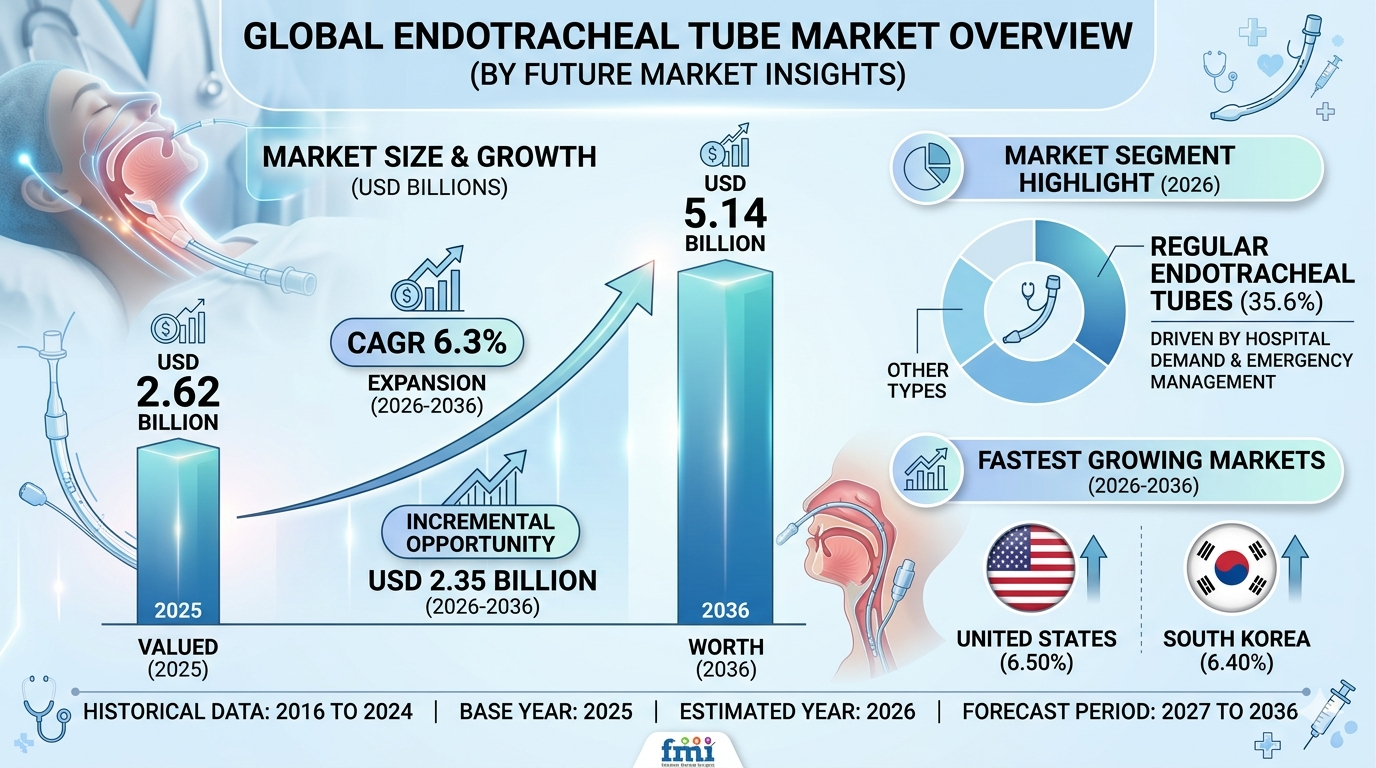
The global endotracheal tube market is projected to witness strong expansion over the next decade, supported by expanding critical care infrastructure, a growing geriatric population, and a rising prevalence of chronic respiratory diseases. The market is expected to grow steadily, creating an incremental opportunity of USD 2.35 billion between 2026 and 2036, according to the latest analysis by Future Market Insights (FMI).
Market growth is being shaped by the evolution of standard airway management products into specialized infection-control and critical care segments. Post-pandemic expansions in hospital ICU capacity and ventilator inventory across global markets have structurally cemented a recurring baseline demand for single-use medical devices. Furthermore, the rising volume of surgical procedures requiring anesthesia support and emergency airway management continues to propel the global market forward.
While traditional regular endotracheal tubes continue to dominate installations, manufacturers are increasingly focusing on specialty and premium formats. Features such as specialized coatings, high-performance materials (like medical-grade PVC and silicone), and design configurations aimed at mitigating hospital-acquired infection risks (such as Ventilator-Associated Pneumonia) are rapidly emerging as key differentiators.
Global Endotracheal Tube Market Snapshot (2026–2036)
Incremental opportunity value (2026–2036): USD 2.35 billion
Dominant product category: Regular endotracheal tubes (35.6% market share in 2026)
Dominant route type segment: Orotracheal insertion (61.7% market share)
Dominant application segment: Emergency treatment (48.3% market share)
Key material segments: Polyvinyl Chloride (PVC), Silicone, Thermoplastic Elastomer (TPE)
Primary demand channel: Direct sales to hospitals via bulk procurement contracts
Momentum in the Market
Beginning from a solid post-pandemic foundation of expanded ICU setups, the global endotracheal tube market demonstrates accelerated growth throughout the forecast period as healthcare facilities prioritize clinical outcomes and infection control. Between 2026 and 2036, the ongoing modernization of hospital infrastructure and rising surgical volumes worldwide are expected to significantly boost demand for integrated airway management solutions.
Increasing healthcare spending and the expansion of national medical programs are encouraging hospital systems to establish long-term procurement contracts. From 2036 onward, innovation in premium sub-formats and advanced multi-lumen configurations is expected to further strengthen market expansion. Tubes optimized for specific clinical environments—such as neonatals, emergency trauma care, and long-term mechanical ventilation—are witnessing a rapid surge in adoption.
The Reasons Behind the Market’s Growth
Demand for endotracheal tubes globally is rising due to multiple structural, demographic, and technological factors reshaping the clinical healthcare ecosystem.
Expanding Critical Care and ICU Infrastructure
Post-pandemic hospital capacity growth in major economies has structurally locked in higher recurring usage volumes. Multi-year Group Purchasing Organization (GPO) contracts ensure stable and predictable demand for single-use devices.
Surge in Chronic Respiratory Illnesses and Geriatric Demographics
An aging global population prone to acute respiratory failures and advanced pulmonary diseases is fueling higher admission rates to intensive care units, increasing the need for prolonged mechanical ventilation support.
Shift toward Single-Use and Infection-Control Formats
Hospitals are strictly pivoting toward single-use medical devices to lower the risk of cross-contamination and combat hospital-acquired infections, directly favoring high-quality disposable tube manufacturers.
Emerging Market Infrastructure Development
Large-scale public health programs and infrastructure expansions in developing countries are expanding access to organized clinical care, rapidly boosting the absolute volume of emergency and elective surgical setups.
Top Segment Application Type
Hospitals and Emergency Units Lead Market Demand
Hospitals represent the core hub for airway management products, supported by intensive care unit expansion and standard protocols requiring mandatory intubation capabilities during major surgeries and emergency trauma care.
Segmental Analysis
Regular endotracheal tubes: Will hold 35.6% of the market share for its product type in 2026, supported by cost efficiency and universal clinical familiarity.
Orotracheal route: Commands a dominant 61.7% share of the route type segment, operating as the primary choice for standard airway management.
Emergency treatment: Leads applications with a 48.3% share, driven heavily by trauma care and rapid sequence intubation needs.
Premium formats: Rapidly growing segment as buyers seek products with optimal bioavailability and strict regulatory compliance.
Regional Development: Supply Chain Localization and Infrastructure Expansion
The global manufacturing and consumption landscape is diversifying, with regional clusters scaling up production to satisfy local clinical demand and international compliance metrics.
North America & Western Europe: Anchored by well-established healthcare systems, advanced ICU setups, and leading operator investments in premium branded medical consumables.
India: Driven by extensive public healthcare infrastructure programs like Ayushman Bharat, accelerating the transition from unbranded suppliers to certified, high-quality operators.
Asia-Pacific (China, Japan, South Korea): Expanding rapidly due to massive hospital expansions, an accelerating aging demographic, and localized regional supply chains established by multinational distributors.
Challenges, Trends, Opportunities, and Drivers
Drivers
Structural demand from expanded post-pandemic ICU capacity
High volume of surgeries requiring anesthesia support
Universal clinical shift toward single-use medical products
Rising global prevalence of respiratory conditions
Opportunities
Development of specialty sub-formats for pediatric and neonatal care
Integration of infection-mitigating materials and advanced coatings
Supply chain optimization through e-commerce and specialized retail channels
Expansion into emerging healthcare economies via certified regional production
Trends
Transition toward premium-tier sub-formats with enhanced safety features
Increased adoption of double-lumen configurations for lung isolation
Rising prominence of e-commerce healthcare platforms for medical distribution
Raw material reformulations focusing on high-grade biocompatible elastomers
Challenges
Fluctuating costs of high-grade medical raw materials
Intense pricing pressure on commodity-level players
Navigating stringent and evolving global medical device regulations
Managing rigorous hospital procurement and competitive tender benchmarks
The Competitive Environment
The global endotracheal tube market is characterized by a mix of established medical device conglomerates and agile regional manufacturers focusing on product compliance, large-scale output efficiency, and regional supply networks. Leading companies include:
Medtronic plc
Teleflex Incorporated
Smiths Medical
Becton, Dickinson and Company (BD)
ConvaTec Group
Nihon Kohden Corporation
Well Lead Medical
These industry participants are securing multi-year volume commitments through direct hospital contracts while investing in premium product differentiation and regulatory-compliant manufacturing lines to sustain long-term market dominance.
Future Outlook: Toward Specialized and Infection-Resilient Airway Management
The global endotracheal tube market is navigating a transformative decade centered around clinical specialization, material innovation, and patient safety. Future clinical settings will continue to phase out uncertified inventory in favor of branded, safety-tested modules that work seamlessly alongside modern mechanical ventilators and monitoring systems. As global medical standards elevate, endotracheal tubes will remain a crucial baseline necessity in ensuring efficient, safe, and dependable respiratory care across the healthcare spectrum.
For a comprehensive strategic outlook and detailed analysis of technological developments shaping the industry, readers can explore the full report on the official Future Market Insights website: https://www.futuremarketinsights.com/reports/endotracheal-tube-market
- Art & Craft
- Causes & Effect
- Dance & Music
- Health & Fitness
- Food & Wellness
- Historic Places
- Homes & Gardening
- Literature & Knowledge
- Science and Technology
- Social Networking
- Social Commerce
- Party & Celebration
- Religion & Festivals
- Shopping & Vendors
- Sports & Games
- Film & Theater
- Digital Creators & Community
- Influencer CCC
- Corporate & Collaboration
- Startup & Scope
- Investment & Growth
- VC & Angel Investors
- Agriculture & farmers
- Nature & Universe
- News & Media
- Real Estate & Property
- Artificial Intellegence
- Political Coverage
- Winners & Loosers
 Portuguese (Brazil)
 English
 Arabic
 Hindi
Hindi
 French
 Spanish
 Portuguese
 Deutsch
 Turkish
 Dutch
Dutch
 Italiano
 Russian
 Romaian
 Greek
Greek
