English
 Arabic
 French
 Spanish
 Portuguese
 Deutsch
 Turkish
 Dutch
Dutch
 Italiano
 Russian
 Romaian
 Portuguese (Brazil)
 Greek
Greek
Influencer Marketing Trends in 2026
Uncategorized |
2026-06-15 07:32:15
 Social Networth OS
 Creator Commerce
 Launch Startup
 Global News
 Creator Award
 Talkfever App
Mostra tutti i risultati
Talkfever App
Mostra tutti i risultati

Passa a Pro
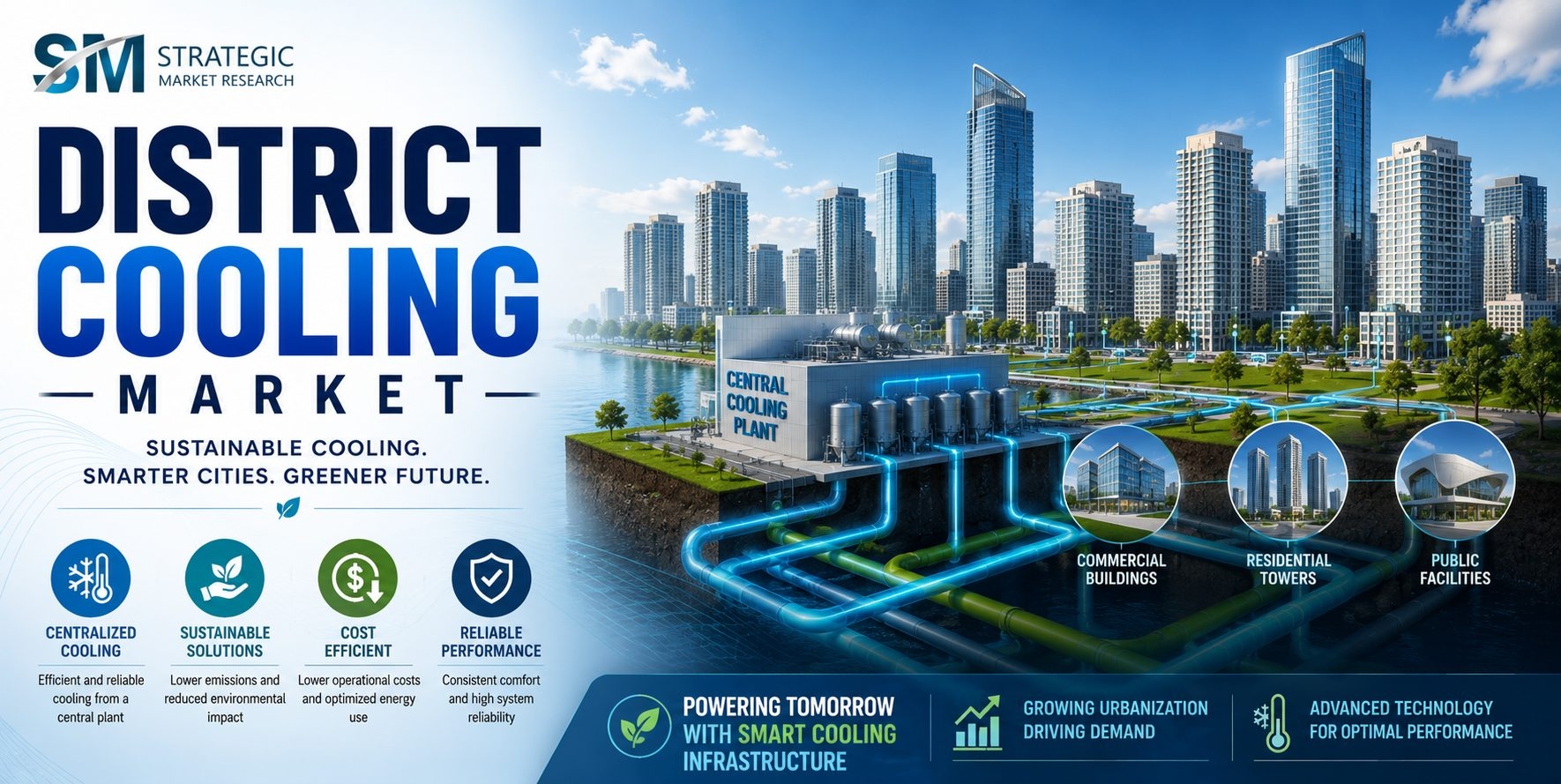
The global district cooling market is witnessing substantial expansion as governments, municipalities, and urban infrastructure developers increasingly prioritize sustainable and energy-efficient cooling solutions to address rising temperatures, growing urban populations, and escalating electricity consumption. District cooling systems deliver centrally generated chilled water to multiple buildings through insulated underground pipeline networks, offering an efficient alternative to conventional standalone air conditioning systems.
With accelerating urbanization, expanding smart city initiatives, and increasing climate-related cooling demand, district cooling is becoming a critical component of next-generation urban infrastructure. The technology helps reduce energy consumption, lower carbon emissions, minimize operational expenses, and ease pressure on electricity grids while improving overall cooling efficiency across densely populated urban environments.
The market is attracting significant investments across airports, commercial districts, hospitals, universities, industrial parks, mixed-use developments, data centers, and large-scale real estate projects. Governments and city planners are increasingly incorporating district cooling systems into long-term sustainability and decarbonization strategies to support energy transition goals.
District cooling systems function by generating chilled water at centralized cooling facilities and distributing it through underground insulated piping networks to connected buildings for air conditioning and space cooling applications. These systems typically utilize technologies including electric chillers, absorption chillers, thermal energy storage systems, seawater cooling, and renewable energy-based cooling integration.
Compared to traditional HVAC systems installed individually in buildings, district cooling infrastructure can reduce energy usage by nearly 30–50%, while also lowering maintenance requirements and optimizing cooling capacity across multiple facilities. In addition, centralized cooling networks help reduce refrigerant emissions, improve urban air quality, and mitigate urban heat island effects.
The market continues to gain momentum in regions experiencing high cooling demand, extreme weather conditions, and rapid infrastructure development. Large-scale deployment is increasingly visible across smart cities, financial districts, tourism hubs, industrial zones, and commercial centers where centralized cooling offers long-term economic and environmental benefits.
Advancements in digital monitoring systems, AI-enabled load management, IoT-driven energy optimization, renewable-powered cooling plants, and thermal storage technologies are further enhancing the operational efficiency and scalability of district cooling networks globally.
Accelerating urban development remains one of the strongest growth drivers for the district cooling market. Growing metropolitan populations are increasing demand for commercial buildings, residential complexes, transportation infrastructure, airports, hospitals, and retail developments that require reliable large-scale cooling systems.
Smart city initiatives are increasingly integrating district cooling infrastructure into urban master plans due to its ability to improve energy efficiency and reduce environmental impact. Governments are recognizing centralized cooling systems as an essential element of sustainable urban planning.
Large-scale smart city projects across the Middle East, Asia-Pacific, and Europe are actively incorporating district cooling networks into technology parks, mixed-use developments, and newly developed urban districts.
Cooling infrastructure accounts for a substantial share of global electricity consumption, particularly in regions with high ambient temperatures. Conventional HVAC systems significantly contribute to peak electricity demand, placing additional strain on power infrastructure.
District cooling systems improve energy efficiency through centralized cooling optimization, thermal storage capabilities, and diversified load management. These systems reduce electricity consumption while enhancing cooling reliability and operational performance.
Increasing concerns regarding energy costs and grid stability are encouraging municipal authorities, industrial operators, and commercial developers to adopt centralized cooling infrastructure.
Rising global temperatures and the increasing frequency of extreme heat events are significantly accelerating global cooling demand. Urban areas are experiencing higher heat stress levels due to dense construction activity, population growth, and expanding industrialization.
District cooling systems help reduce environmental impact by lowering greenhouse gas emissions associated with traditional air conditioning technologies. The systems also support renewable energy integration and contribute to broader sustainability objectives.
As governments strengthen climate policies and carbon reduction commitments, district cooling is becoming increasingly important in sustainable urban infrastructure planning.
Governments and regulatory agencies worldwide are implementing stricter building efficiency standards and sustainability regulations aimed at reducing building-related energy consumption and emissions.
Several countries are supporting district energy infrastructure through policy incentives, infrastructure investment programs, tax benefits, and green building certification initiatives. Urban planning authorities are also encouraging or mandating centralized cooling systems in large-scale development projects.
Regulations targeting inefficient HVAC systems and refrigerant emissions are further contributing to market growth.
Despite long-term operational and energy savings, district cooling infrastructure requires considerable upfront investment for centralized cooling plants, underground distribution networks, pumping systems, and thermal storage facilities.
The substantial infrastructure costs can create financial challenges, particularly in developing economies with limited funding capabilities. Project feasibility often depends on favorable regulatory frameworks, long-term customer agreements, and high urban density.
Extended payback periods may discourage some private developers from adopting district cooling systems.
Installing underground chilled water distribution networks in densely populated cities can be technically challenging and disruptive. Retrofitting existing urban areas often requires extensive civil engineering work, coordination with utility providers, and regulatory approvals.
Space limitations for centralized cooling plants and underground network routing can further complicate implementation in mature urban environments.
District cooling systems are most economically viable in densely populated urban areas with concentrated cooling demand. Lower-density suburban developments often do not generate sufficient cooling loads to justify large-scale infrastructure investment.
This dependency on urban density limits adoption potential in smaller cities and rural regions.
Large-scale smart city initiatives are generating substantial growth opportunities for district cooling providers. Governments are increasingly investing in integrated urban infrastructure that emphasizes sustainability, energy optimization, and digital connectivity.
Major infrastructure developments such as airports, industrial corridors, tourism hubs, technology parks, and mixed-use commercial communities are emerging as key deployment areas.
Countries across the Middle East and Asia-Pacific are investing heavily in centralized cooling systems to support urban expansion projects.
The integration of renewable energy technologies such as solar power, geothermal energy, and waste heat recovery systems is creating new opportunities for sustainable district cooling infrastructure.
Hybrid cooling systems utilizing renewable electricity and advanced thermal storage technologies can significantly reduce operational expenses and carbon emissions.
The growing global focus on net-zero infrastructure development is expected to further accelerate adoption of renewable-powered district cooling systems.
The rapid growth of cloud computing, artificial intelligence, and digital transformation is fueling expansion in global data center infrastructure. Data centers require reliable, high-capacity cooling systems to maintain operational stability.
District cooling provides an energy-efficient alternative for large-scale data center cooling while supporting sustainability and energy optimization goals.
Growing investments in hyperscale data centers are expected to generate strong long-term opportunities for district cooling providers.
Industrial facilities, pharmaceutical plants, hospitals, laboratories, and research centers are increasingly adopting centralized cooling systems to improve operational efficiency and temperature reliability.
Healthcare infrastructure, in particular, requires uninterrupted cooling performance for critical operations, making district cooling an attractive long-term solution.
Thermal energy storage systems are becoming increasingly important in district cooling infrastructure. These systems store chilled water or ice during off-peak electricity hours and utilize it during periods of peak demand, improving energy efficiency and reducing electricity costs.
Thermal storage also supports grid stability by reducing pressure on electricity networks during high-temperature periods.
Artificial intelligence and IoT technologies are increasingly being integrated into district cooling networks for predictive maintenance, real-time monitoring, demand forecasting, and automated energy optimization.
Advanced analytics platforms enable operators to improve operational efficiency, minimize energy losses, and optimize cooling output based on occupancy trends and environmental conditions.
Natural cooling solutions utilizing seawater, underground aquifers, and deep lake cooling systems are gaining traction in environmentally focused and coastal regions.
These technologies significantly reduce electricity usage by leveraging naturally cold water resources for heat exchange applications.
Several cities are actively exploring sustainable district cooling solutions utilizing geothermal and marine-based cooling systems.
Infrastructure providers are increasingly focusing on modular district cooling systems that support phased expansion based on evolving urban growth and cooling requirements.
Scalable cooling infrastructure improves project flexibility while reducing financial risk associated with large upfront investments.
The district cooling market remains moderately consolidated, with major infrastructure companies, engineering firms, utility operators, and energy service providers competing across large-scale urban infrastructure projects.
Competition is primarily focused on cooling efficiency, infrastructure financing capabilities, digital energy management integration, operational reliability, and long-term service agreements.
Leading companies are strengthening their market presence through strategic collaborations with governments, renewable energy providers, construction firms, and smart city developers.
Investments in AI-enabled optimization technologies, thermal storage systems, and sustainable cooling infrastructure are becoming key competitive differentiators.
Mergers, acquisitions, public-private partnerships, and infrastructure modernization projects are also increasing as companies pursue geographic expansion and long-term infrastructure ownership opportunities.
The Middle East represents one of the largest and fastest-growing district cooling markets due to extreme climatic conditions, rapid urban development, and substantial cooling demand.
Countries across the Gulf region are heavily investing in district cooling infrastructure for smart cities, airports, tourism projects, and commercial developments. Government sustainability initiatives and energy efficiency programs continue to support strong market growth.
Asia-Pacific is experiencing rapid market expansion driven by urbanization, industrial growth, and smart city infrastructure development. Increasing construction activity across China, India, Singapore, and Southeast Asia is supporting widespread adoption.
Growing electricity demand and rising environmental concerns are encouraging governments to implement centralized cooling systems as part of urban sustainability initiatives.
Europe is increasingly investing in sustainable district energy systems as part of broader carbon reduction and energy transition objectives. Renewable energy integration, waste heat recovery, and environmentally efficient cooling technologies are supporting regional market development.
Several European cities are modernizing urban infrastructure through integrated district heating and cooling systems.
North America is witnessing steady growth driven by adoption across university campuses, healthcare facilities, airports, military infrastructure, and commercial real estate projects.
Increasing focus on ESG compliance, energy-efficient buildings, and smart infrastructure technologies is further contributing to regional market growth.
The district cooling market is being significantly shaped by rising electricity prices, urban climate adaptation strategies, global decarbonization policies, and increasing investments in sustainable infrastructure.
Energy supply disruptions and growing concerns regarding grid reliability are increasing interest in energy-efficient cooling systems capable of reducing electricity dependence and improving energy resilience.
At the same time, stricter green building regulations and carbon neutrality commitments are strengthening long-term market opportunities. Advancements in AI-based cooling optimization, renewable energy integration, and thermal storage technologies are positioning district cooling as a vital component of future smart city ecosystems.
The market is expected to maintain strong long-term growth as urban populations expand, climate temperatures rise, and governments continue prioritizing sustainable and energy-efficient cooling infrastructure worldwide.
Micro Combined Heat & Power Market