



 IMS for Investors
 Global News
 Vdo Junction
 Talkfever App
 Upcoming
🚀 Reinventing Reality: The Rise of Physical AI in Designing, Building, and Operating the World Around Us
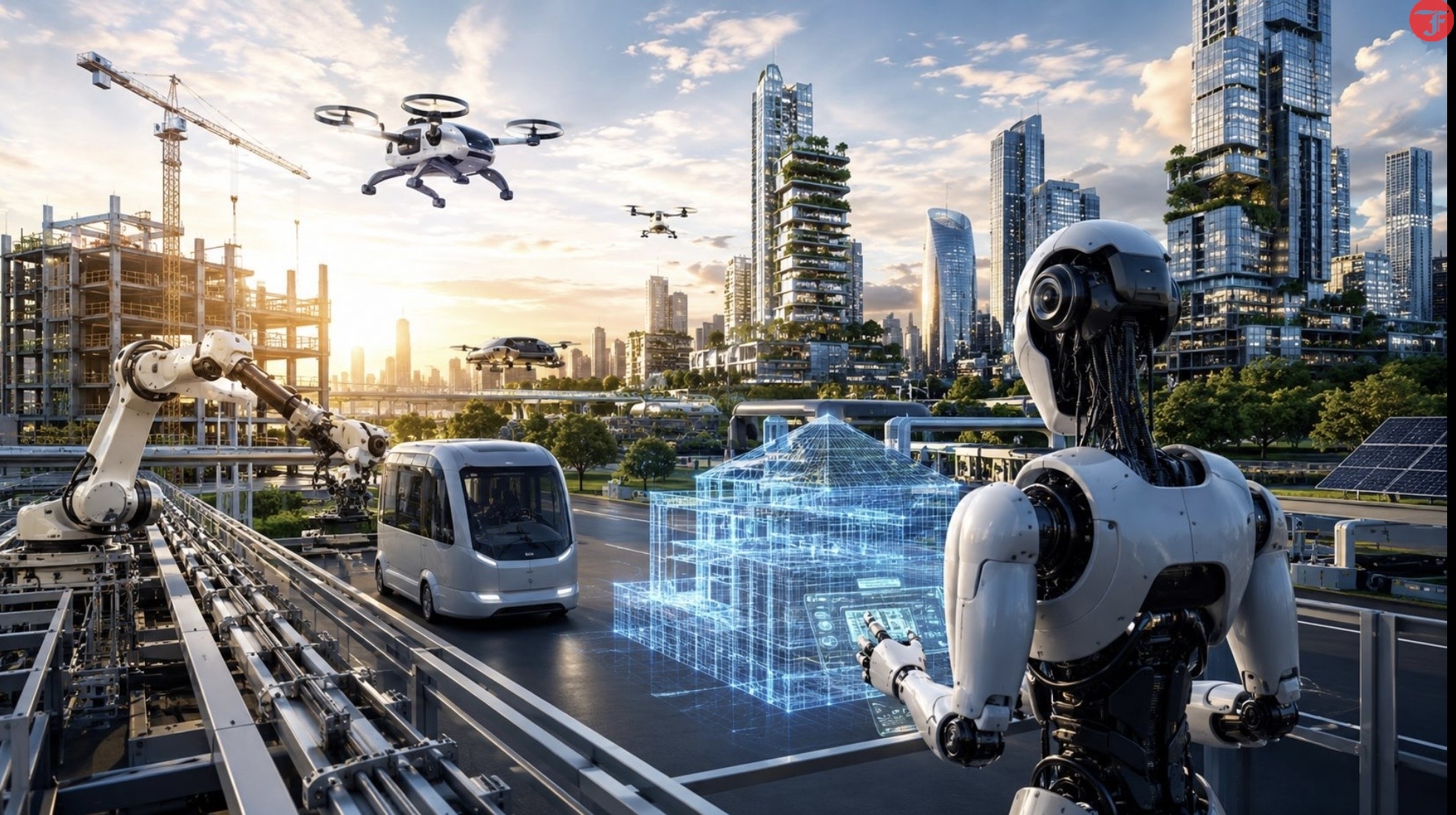
Artificial Intelligence is no longer confined to screens, software, and digital workflows. A new frontier is emerging—Physical AI—where intelligence moves beyond prediction and enters the real world to perceive, reason, and act. From autonomous construction sites and smart factories to intelligent infrastructure and adaptive buildings, Physical AI is transforming how we design, build, and operate the environments around us. 🌍🤖
Imagine a world where:
✅ Buildings continuously optimize energy consumption and occupant comfort.
✅ Robots collaborate seamlessly with human teams on construction projects.
✅ Digital twins simulate real-world scenarios before decisions are executed.
✅ Infrastructure predicts maintenance needs before failures occur.
✅ Cities become adaptive ecosystems powered by real-time intelligence.
Physical AI represents the convergence of Artificial Intelligence, Robotics, IoT, Digital Twins, Computer Vision, and Edge Computing, creating systems that can understand and interact with the physical world in unprecedented ways. Industry leaders increasingly view this evolution as the next major phase of AI, extending intelligence from digital content creation into real-world operations and decision-making.
For architects, engineers, urban planners, manufacturers, technology leaders, and investors, this is more than a technological shift—it is a fundamental transformation of the global economy and the future of human-machine collaboration. Physical AI is not simply automating tasks; it is enabling a smarter, safer, more sustainable, and more responsive built environment.
As we move toward an era where intelligence is embedded into the physical fabric of society, the question is no longer if Physical AI will reshape industries, but how quickly organizations will adapt to this new reality.
📖 Read the full article:
https://medium.com/@jckapadia003/reinventing-reality-the-rise-of-physical-ai-in-designing-building-and-operating-the-world-around-bc1c7950f941
#PhysicalAI #ArtificialIntelligence #DigitalTransformation #SmartCities #DigitalTwins #Robotics #Industry40 #ConstructionTechnology #Engineering #Innovation #FutureOfWork #IndustrialAI #SmartInfrastructure #Automation #IoT #MachineLearning #TechnologyLeadership #UrbanInnovation #BuiltEnvironment #FutureTech
Artificial Intelligence is no longer confined to screens, software, and digital workflows. A new frontier is emerging—Physical AI—where intelligence moves beyond prediction and enters the real world to perceive, reason, and act. From autonomous construction sites and smart factories to intelligent infrastructure and adaptive buildings, Physical AI is transforming how we design, build, and operate the environments around us. 🌍🤖
Imagine a world where:
✅ Buildings continuously optimize energy consumption and occupant comfort.
✅ Robots collaborate seamlessly with human teams on construction projects.
✅ Digital twins simulate real-world scenarios before decisions are executed.
✅ Infrastructure predicts maintenance needs before failures occur.
✅ Cities become adaptive ecosystems powered by real-time intelligence.
Physical AI represents the convergence of Artificial Intelligence, Robotics, IoT, Digital Twins, Computer Vision, and Edge Computing, creating systems that can understand and interact with the physical world in unprecedented ways. Industry leaders increasingly view this evolution as the next major phase of AI, extending intelligence from digital content creation into real-world operations and decision-making.
For architects, engineers, urban planners, manufacturers, technology leaders, and investors, this is more than a technological shift—it is a fundamental transformation of the global economy and the future of human-machine collaboration. Physical AI is not simply automating tasks; it is enabling a smarter, safer, more sustainable, and more responsive built environment.
As we move toward an era where intelligence is embedded into the physical fabric of society, the question is no longer if Physical AI will reshape industries, but how quickly organizations will adapt to this new reality.
📖 Read the full article:
https://medium.com/@jckapadia003/reinventing-reality-the-rise-of-physical-ai-in-designing-building-and-operating-the-world-around-bc1c7950f941
#PhysicalAI #ArtificialIntelligence #DigitalTransformation #SmartCities #DigitalTwins #Robotics #Industry40 #ConstructionTechnology #Engineering #Innovation #FutureOfWork #IndustrialAI #SmartInfrastructure #Automation #IoT #MachineLearning #TechnologyLeadership #UrbanInnovation #BuiltEnvironment #FutureTech
🚀 Reinventing Reality: The Rise of Physical AI in Designing, Building, and Operating the World Around Us
Artificial Intelligence is no longer confined to screens, software, and digital workflows. A new frontier is emerging—Physical AI—where intelligence moves beyond prediction and enters the real world to perceive, reason, and act. From autonomous construction sites and smart factories to intelligent infrastructure and adaptive buildings, Physical AI is transforming how we design, build, and operate the environments around us. 🌍🤖
Imagine a world where:
✅ Buildings continuously optimize energy consumption and occupant comfort.
✅ Robots collaborate seamlessly with human teams on construction projects.
✅ Digital twins simulate real-world scenarios before decisions are executed.
✅ Infrastructure predicts maintenance needs before failures occur.
✅ Cities become adaptive ecosystems powered by real-time intelligence.
Physical AI represents the convergence of Artificial Intelligence, Robotics, IoT, Digital Twins, Computer Vision, and Edge Computing, creating systems that can understand and interact with the physical world in unprecedented ways. Industry leaders increasingly view this evolution as the next major phase of AI, extending intelligence from digital content creation into real-world operations and decision-making.
For architects, engineers, urban planners, manufacturers, technology leaders, and investors, this is more than a technological shift—it is a fundamental transformation of the global economy and the future of human-machine collaboration. Physical AI is not simply automating tasks; it is enabling a smarter, safer, more sustainable, and more responsive built environment.
As we move toward an era where intelligence is embedded into the physical fabric of society, the question is no longer if Physical AI will reshape industries, but how quickly organizations will adapt to this new reality.
📖 Read the full article:
https://medium.com/@jckapadia003/reinventing-reality-the-rise-of-physical-ai-in-designing-building-and-operating-the-world-around-bc1c7950f941
#PhysicalAI #ArtificialIntelligence #DigitalTransformation #SmartCities #DigitalTwins #Robotics #Industry40 #ConstructionTechnology #Engineering #Innovation #FutureOfWork #IndustrialAI #SmartInfrastructure #Automation #IoT #MachineLearning #TechnologyLeadership #UrbanInnovation #BuiltEnvironment #FutureTech



 Arabic
 French
 Spanish
 Portuguese
 Deutsch
 Turkish
 Dutch
Dutch
 Italiano
 Russian
 Romaian
 Portuguese (Brazil)
 Greek
Greek