English
 Arabic
 French
 Spanish
 Portuguese
 Deutsch
 Turkish
 Dutch
Dutch
 Italiano
 Russian
 Romaian
 Portuguese (Brazil)
 Greek
Greek
Vinny's Pizza Where Flavor, Tradition, and Community Come Together
Food |
2026-02-21 13:44:29
 Social Networth OS
 Creator Commerce
 Launch Startup
 Global News
 Creator Award
 Talkfever App
Ver todos
Talkfever App
Ver todos

Atualizar para Plus
In the competitive landscape of the food industry, the product is only half the battle; the presentation and delivery are the other half. For pizzerias and restaurants, the journey of a pizza from the oven to the customer’s table is critical. That journey is facilitated by one essential item: the pizza box. While it may seem like a simple commodity, choosing the right pizza box can impact food quality, customer satisfaction, brand perception, and even your bottom line.
Whether you are running a high-volume delivery chain or a boutique artisanal pizzeria, selecting the right packaging solution requires careful consideration. From the sturdy corrugated box to the versatile folding box and the complementary utility of paper bags, every element plays a role. This guide will walk you through everything you need to know to make the best choice for your business.
When people think of pizza packaging box, the corrugated box is the industry standard. It is the workhorse of the delivery world, and for good reason. A corrugated box is distinct from standard cardboard because it features a fluted medium sandwiched between two linerboards. This structure provides rigidity, durability, and insulation—three things that are non-negotiable for delivering hot pizzas.
Why choose a corrugated box?
For businesses prioritizing delivery over dine-in, investing in a high-quality corrugated box is not an area to cut costs. A flimsy box leads to cold, damaged pizzas, which translates to negative reviews and lost repeat business.
While the corrugated box is the king of delivery, the folding box (often referred to as a carton or clamshell) offers unique advantages, particularly for businesses that need to manage storage space efficiently.
A folding box is typically manufactured as a flat sheet that is scored and slotted, allowing it to be quickly assembled into a three-dimensional container.
Benefits of the Folding Box:
When deciding between a standard rigid setup and a folding box, consider your volume and kitchen layout. If you are a high-volume delivery spot, the stackability of pre-assembled boxes might be preferred, but for counter-service or space-constrained venues, the folding box is a game-changer.
Selecting the right pizza box is only part of the packaging equation. You must also consider how the customer will carry their order, especially if they are ordering sides, drinks, or multiple pizzas. This is where paper bags become an essential part of your packaging strategy.
Integrating paper bags into your delivery and takeaway service offers several benefits:
When sourcing paper bags, ensure they are reinforced and have strong handles. The last thing you want is the bottom of the bag tearing out, sending the pizza crashing to the floor. The bag should be as reliable as the box inside it.
Once you have decided on the material type—be it a corrugated box or a folding box—you need to nail the specifications.
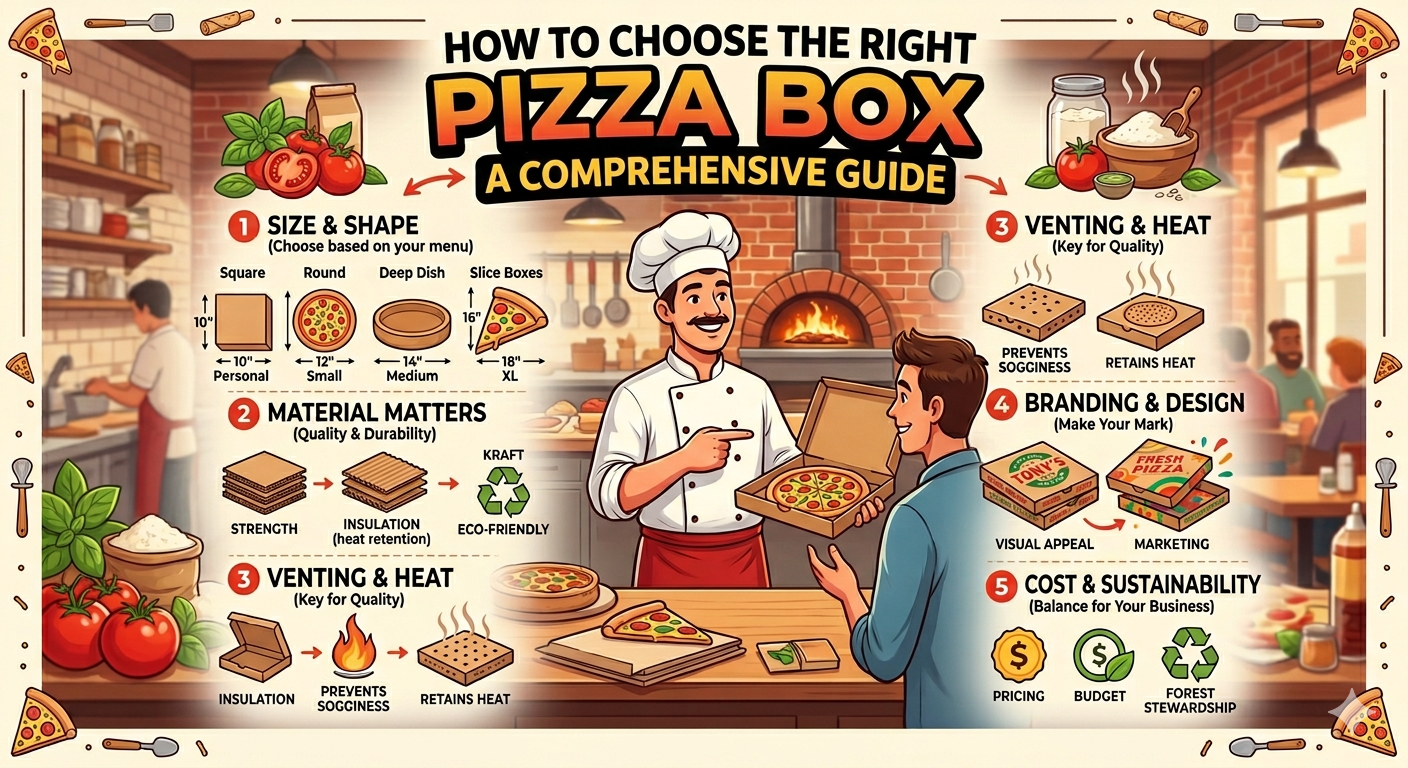
Sizing: It sounds obvious, but the box must fit the pizza. However, it isn't just about diameter. A box that is too large allows the pizza to slide around during delivery, causing the toppings to shift to one side (the dreaded "pizza shift"). A box that is too small will squish the crust. Measure your pizzas accurately, including the "lift" from toppings, and order containers that offer a snug fit with about half an inch of clearance.
Ventilation: One of the biggest enemies of pizza quality is steam. If a hot pizza is sealed in a box with no airflow, the steam gets trapped, condensates on the lid, and drips back onto the crust. The result? A soggy, chewy crust. Look for a corrugated box design that includes strategically placed ventilation holes or "chimneys." These allow excess moisture to escape while retaining heat, keeping the crust crispy.
Your packaging is the final touchpoint of the customer experience. It is an extension of your restaurant's ambiance. A generic, blank white box conveys utility, but a custom-printed box conveys professionalism and pride.
Finally, modern businesses cannot ignore the environmental impact of their packaging. Pizza boxes are historically difficult to recycle because of grease contamination. However, the industry is evolving.
Many manufacturers now produce a corrugated box made from recycled materials or certified sustainable forests (FSC certified). Furthermore, compostable options are becoming more affordable. If you use paper bags, ensure they are sourced from sustainable vendors. Promoting your packaging as "100% recyclable" or "compostable" can give you a competitive edge in a crowded market.
Choosing the right pizza box is a strategic business decision. It requires balancing functionality, cost, and branding. The durable corrugated box remains the gold standard for heat retention and protection during delivery. The folding box offers unmatched efficiency for storage and assembly, perfect for fast-paced environments or slice shops. And let’s not forget the utility of paper bags, which provide convenience and an extra layer of marketing for the complete order.