English
 Arabic
 French
 Spanish
 Portuguese
 Deutsch
 Turkish
 Dutch
Dutch
 Italiano
 Russian
 Romaian
 Portuguese (Brazil)
 Greek
Greek
☎1-855-690-1232-Ways to call Disney Customer Service Through Phone Number, Chat and Email Options: A Complete-Guide
Other |
2025-04-22 15:11:35
 Social Networth OS
 Creator Commerce
 Launch Startup
 Global News
 Creator Award
 Talkfever App
See All
Talkfever App
See All

Upgrade to Pro
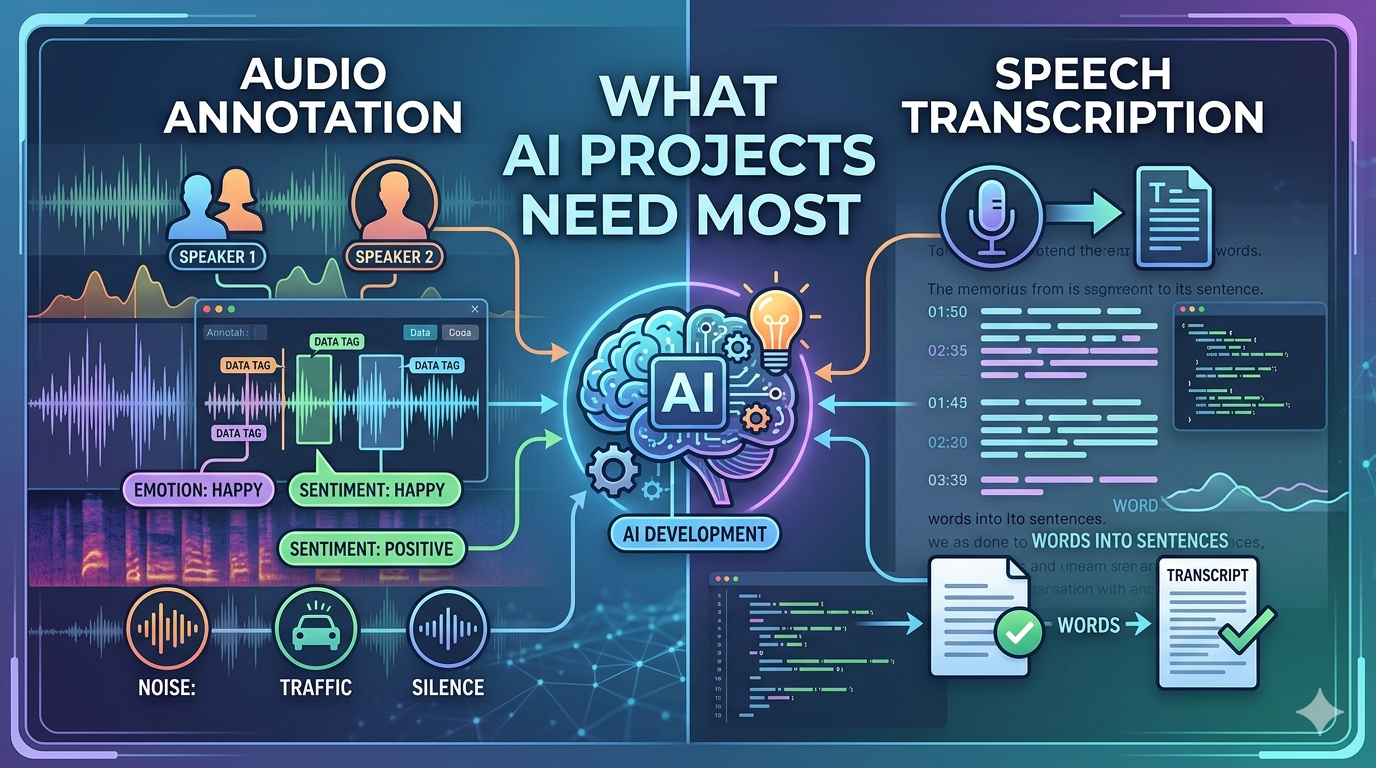
In the rapidly evolving landscape of artificial intelligence, high-quality data remains the backbone of successful model development. Among the most critical components of audio-based AI systems are audio annotation and speech transcription—two processes that are often misunderstood or used interchangeably.
For businesses working with a data annotation company or exploring data annotation outsourcing, understanding the distinction between these two approaches is essential. Each plays a unique role in training AI models, and choosing the right one can significantly impact performance, scalability, and accuracy.
At Annotera, we help organizations navigate this decision with precision. This article breaks down the differences, use cases, and strategic importance of audio annotation and speech transcription to help AI projects determine what they truly need.
Speech transcription is the process of converting spoken language into written text. It is a foundational task in AI, particularly for systems built around Automatic Speech Recognition (ASR).
In simple terms, transcription answers the question: “What is being said?”
Speech transcription is widely used in applications such as:
Voice assistants
Meeting summarization tools
Subtitling and captioning
Customer support analytics
High-quality transcription datasets are critical for training ASR models because they provide direct mappings between audio signals and textual output.
Focuses solely on spoken words
Produces clean, readable text output
Often includes punctuation and formatting
May involve verbatim or intelligent transcription styles
For AI projects that primarily need to interpret language, such as chatbots or voice search systems, speech transcription is indispensable.
Audio annotation is a broader and more sophisticated process. It involves labeling audio data with multiple layers of metadata—not just text, but also contextual and acoustic information.
Audio annotation answers a more complex question: “What is happening in this audio?”
This process includes:
Speech-to-text transcription
Speaker identification (who is speaking)
Timestamping (when something occurs)
Sound event detection (e.g., sirens, background noise)
Emotion and sentiment tagging
Unlike transcription alone, audio annotation transforms raw audio into structured, machine-readable training data.
Multi-layered and context-rich
Includes both speech and non-speech elements
Supports advanced AI tasks beyond language recognition
Enables deeper understanding of audio environments
A professional audio annotation company like Annotera ensures that datasets are not only accurate but also aligned with the specific objectives of AI models.
Although related, these processes serve distinct purposes in AI development.
| Aspect | Speech Transcription | Audio Annotation |
|---|---|---|
| Scope | Converts speech to text | Labels all audio elements |
| Complexity | Relatively simple | Multi-dimensional |
| Output | Text | Structured metadata + text |
| Use Case | ASR, subtitles | NLP, emotion AI, sound detection |
| Context Awareness | Limited | High |
One critical misconception is that audio annotation is simply transcription. In reality, transcription is just one component of the broader annotation workflow.
Certain AI applications rely heavily on textual accuracy rather than contextual audio understanding. In such cases, speech transcription is the primary requirement.
Automatic Speech Recognition (ASR) Systems
Models need large volumes of accurately transcribed audio-text pairs.
Voice Search and Virtual Assistants
Systems like voice-enabled apps depend on converting speech into commands.
Content Accessibility
Transcriptions enable indexing, searchability, and accessibility for audio/video content.
Customer Interaction Analysis
Businesses analyze transcripts of calls to extract insights and improve service quality.
For these applications, investing in speech transcription services through data annotation outsourcing ensures scalability and cost efficiency.
For more advanced AI systems, transcription alone is insufficient. These projects require deeper insights into audio data—making audio annotation essential.
Emotion Recognition Systems
Detecting tone, sentiment, and emotional cues requires labeled metadata beyond words.
Speaker Diarization and Identification
Systems must distinguish between multiple speakers and track conversations.
Autonomous Systems and Surveillance
Recognizing environmental sounds (e.g., alarms, crashes) is critical.
Multimodal AI Models
Combining audio with video or text requires rich annotations for context.
Healthcare and Compliance AI
Identifying pauses, stress, or anomalies in speech can be crucial.
Audio annotation enables machines to interpret not just speech, but intent, environment, and interaction dynamics.
Choosing between transcription and annotation often depends on project complexity, but execution quality is equally important.
A specialized data annotation company like Annotera brings:
Domain-specific expertise
Scalable workforce for large datasets
Quality assurance pipelines
Custom annotation guidelines
Many organizations opt for data annotation outsourcing to reduce operational costs while maintaining high-quality output. This is particularly beneficial for startups and enterprises dealing with multilingual or large-scale datasets.
Similarly, partnering with an experienced audio annotation company ensures that even complex annotation tasks—such as emotion tagging or acoustic event detection—are handled with precision.
In practice, the choice is rarely binary. Most modern AI systems benefit from a combination of speech transcription and audio annotation.
Transcription provides linguistic clarity
Annotation adds contextual intelligence
For example:
A call center AI system may use transcription for conversation analysis and annotation for sentiment detection.
A voice assistant may rely on transcription for commands but require annotation for speaker identification and intent detection.
As AI models become more sophisticated, multi-layered datasets are becoming the standard rather than the exception.
Before deciding what your AI project needs most, evaluate the following:
Language understanding → Transcription
Contextual audio intelligence → Annotation
Basic NLP models → Transcription
Advanced AI systems → Annotation
Transcription is generally faster and less expensive
Annotation requires more time and expertise
Outsourcing to a reliable partner ensures efficient scaling without compromising quality.
At Annotera, we specialize in delivering both speech transcription and advanced audio annotation services tailored to AI-driven applications.
As a trusted data annotation company, we offer:
End-to-end data annotation outsourcing
High-quality, multilingual datasets
Custom workflows for diverse industries
Scalable solutions for startups and enterprises
Our expertise as an audio annotation company ensures that your AI models are trained on rich, accurate, and context-aware data—maximizing performance and reliability.
Audio annotation and speech transcription are both essential components of AI development, but they serve different purposes. While transcription focuses on converting speech into text, annotation provides the contextual depth needed for advanced AI capabilities.
The real question is not which one is better—but which one aligns with your project goals.
For simple language-based applications, transcription may be enough. But for complex, real-world AI systems, audio annotation becomes indispensable. In most cases, a hybrid approach delivers the best results.
By partnering with an experienced provider like Annotera, businesses can leverage the full potential of both approaches—ensuring their AI models are accurate, scalable, and future-ready.